Showing posts with label Camping. Show all posts
Sunday, June 17, 2012
Exped Ergo Combi all-in-one hammock camping solution
The Exped Ergo Combi aims to give you the protection of a tent within the comfortable, 'zero gravity' confines of a roomy hammock. It looks like it could offer one of the best nights of sleep you've ever had outdoors.
You can buy various forms of sheltered hammocks from manufacturers like Clark, Hennessy Hammock and Grand Trunk. Some are completely open, leaving you to sleep under the stars. Some have mosquito netting to protect you from pests. Some have waterproof protection for use in foul weather. Some have added insulation on the underside to keep you warm in winter or cooler spring weather.
The Exped Ergo Combi has it all. It packs every type of protection that you could possibly want in the outdoors - save maybe for carnivore repellant - into a package in which you'll never have to worry about hard, cold dirt or poking sticks and rocks.
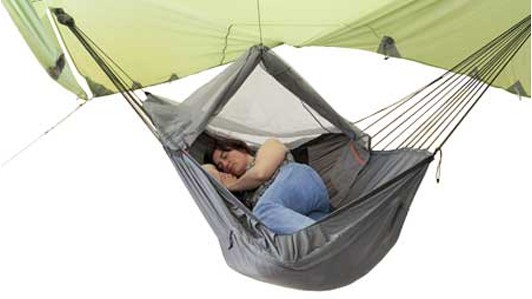
As you can see in the picture, the Ergo Combi begins with a horizontal sleeping system. Most hammocks have the ropes at the tips, but the Ergo puts them on the sides and uses a diagonal suspension system to support the hammock body. We don't know for sure without actually lying in it, but that picture makes it look about as snug and free of pressure points as a womb. Exped says that it developed the horizontal orientation over the course of six years.
With proper sleeping quarters taken care of, Exped throws an array of accompanying features and equipment into the Ergo. It has a waterproof tarp to protect you from rain and provide shade from the sun. The tarp is even oversized so that you can use it as a sun and weather shade for cooking, eating and lounging around camp. Since the tarp isn't attached to the hammock fabric, a separate mesh fly is used to keep bugs from devouring your flesh. An integrated sleeping-pad sleeve fits most of Exped's pads (and we'd assume similarly sized pads from other manufacturers), giving you some extra insulation from the cold air underneath. Exped says that the pad system gives the Ergo winter-camping capabilities, though that would certainly depend on the pad you're using.
The hammock with suspension kit weighs 34 oz (963 g) and the tarp adds another 23 oz (652 g). Depending upon your usage, 3.5 lbs (1.6 kg) may be a little heavy (you could get a number of two-person tents under that weight). However, because it includes separate pieces, it gives you some versatility. You can use just the hammock or just the tarp depending on your comfort level and the weather. It's still not necessarily ultralight, but it does look to provide a solid combination of low weight and sleeping comfort.
The Ergo Combi debuted this year. We don't see a suggested retail price on Exped's site, but the hammock is listed for US$340 at REI and $240 at Backcountry.com. The video below is part one of a three part series that gives you a tour of the design and set-up of the Ergo Combi. Be forewarned: it's not a quick, glamorous promo, but a slow-going instructional video.
Friday, May 25, 2012
Flameless, lightweight Heatstick boils water on the move
The Heatstick from Danish company Heatgear attempts to give backpackers and military personnel a better alternative to the camping stove. Not only is it lightweight, but this flameless heat source can also cook while you hike.
If you follow some of those survivalist shows on television, you've probably seen the concept behind the Heatstick in action. If you don't have a pot or cooking vessel that you can apply directly to flame, you can boil water by heating up a rock, placing it inside the container you have and letting it heat the water inside out. That's essentially what the Heatstick does, only in a more technological way that doesn't involve fire. The lightweight stick draws on a propane and butane mix to heat itself up and boil liquid directly. It has a wide-mouth head that screws into an accompanying water bottle to heat the water in a sealed package. The Heatstick is powered by what Heatgear markets as a Fuelstick, an aluminum cylinder that holds enough fuel to boil up to 6 to 9 liters (1.6 to 2.4 gallons) of water. Heatgear offers different Fuelsticks for different temperature ranges so you have the right fuel for your conditions. You could also mix and match when altitude and fast-paced mountain weather dictate uncertainty on temperature.
The Heatstick aims to provide several clear advantages over a stove. Because it doesn't rely on flame and works inside a container, there's no interference from the wind or weather. It's designed to work across all temperatures (specifically -22 F to 122 + F, -30 C to 50 + C) and weather conditions, unlike stoves, which can be fickle in certain conditions. Also, unlike a stove, you don't need to stop, set things up and wait for your water to boil. As the video below shows, the self-contained nature of the system allows you to cook while moving - you keep hiking to your next destination while the water for your lunch boils in your pack. Tactical customers should like the fact that there's no visible flame, as there is with a stove. The system itself is comparable in weight to an ultralight backpacking stove with fuel - the smaller, .5-liter Heatstick with Fuelstick weighs about a pound (470 g). Unlike a stove that requires a cooking pot, the Heatstick system allows you to cook directly in your water bottle, so you cut out a few more ounces by eliminating the pot from your pack. Everything points to an innovative, useful gadget for backcountry use ... except the price. Heatgear lists the retail price at 2,379 Danish kroners, which translates to about US$460 today. That might not look so bad when you're thinking public funding and military volume, but it's several times more expensive than what you'd pay for any number of backpacking stoves. If Heatgear can bring that price down to a more consumer-friendly level, though, we could see this being quite popular.
Wednesday, May 16, 2012
Snugpak sleeping bag features built-in LED light
The fearsome midnight pee: it's an experience that every camper would prefer to avoid. Yet long nights mixed with (lots of) cheap, light beer and chilly tents have a way of making wee-hour tinkles an inescapable part of the outdoor experience. The Snugpak Chrysalis sleeping bag arms you with a new weapon in the fight to break out of your tent and turn the faucet on high: a built-in LED light.
As helpful as it is, a little, old LED light won't exactly make midnight nature calls a welcome experience. You still have to work the zippers on the sleeping bag, tent and rain fly, wander out into the freezing cold night in your drawers, and stand around peeing while wondering what kind of creature that ominous screech in the brush belongs to.
What the LED will do, though, is get you on your way in and out as quickly as possible. Because without a light on your sleeping bag, you're left thrashing about in the dark trying to find your flashlight or headlamp while waking all your tent mates. With the LED tucked neatly into its own pocket, you simply grab the light and get on with it.
Snugpak claims that the Chrysalis is the only sleeping bag in the world that offers the simple feature. The light fits into a small pouch over your head, where it's readily available when you need it (assuming you remember to keep it in the pouch and don't leave it next to your flashlight under a pile of clothes in the corner). It's a simple upgrade but a smart one that could really help you out every time you camp.
Other than its world-only LED, the Chrysalis is a basic sleeping bag. It comes in several different versions rated anywhere from 2 C to - 20 C (35 F to -4 F). Reflectatherm fabric mirrors body heat and retains extra warmth, while width and length adjustments keep the bag snug. Prices start at around US$81.
We love the idea of a built-in LED, but it would really work well if it was built into something like the Selk'Bag. Then you could have an affixed LED headlamp that couldn't get lost, and you could just get up and go without even taking the bag off. That's the type of pee dreams are made of.
Thursday, May 10, 2012
Nemo's Helio outdoor shower delivers pressurized hot water all over the outdoors
In an attempt to reach out to potential campers and backpackers that don't like the idea of goin' natural for days on end, tent and gear manufacturer Nemo Equipment has developed the Helio shower. Lying between bulky powered systems and basic portable gravity showers, it uses a lightweight, manual pressure system to give you a warm clean-down in the wilderness.
The most advanced camp shower systems on the market employ large equipment like propane tanks and electric water pumps to deliver showering experiences comparable to what you'd get at a hotel. Those systems may be great for an after-hike shower, but they're only practical for car camping, where you have a vehicle to haul them. The lightest, most basic portable showers are essentially black dry bags that rely entirely on Mother Nature - the sun is the water heater and gravity the water pump. Those systems are light enough for back country camping, but they can be lacking in the effective showering department.
The Nemo Helio Pressure Shower attempts to split the difference, maintaining the light weight of the latter with a little of the comfort and convenience of the former. Instead of an electric water pump, Nemo equips the Helios with its Nemoid Foot Pump. To get an even-pressured stream of water, you simply stomp on the Nemoid a few times throughout your shower. Thanks to this pressurization, it's versatile enough for things like washing dishes and spraying your gear down.
Other than that, the Helio is basically the dry bag type of shower. It relies on the sun for heat and packs small and light - around 2 lbs. (.9 kg) and 5.5 x 8 inches (14 x 20.3 cm). You can use it for backcountry camping nearly as easily as car camping. The 11-liter bag gives you about 5 to 7 minutes of shower time before it's time to refill.
The Helio will be available for US$100 in June.
Those interested in the Helio may want to also consider Geiggerig pressurized hydration packs. While they're not designed specifically as showers, they offer a similar manual pressurization system that can give you a shower-type spray.
Sunday, May 6, 2012
Grillcube is a BBQ in a box
Grill aficionados know it: charcoal is superior to gas if you're looking for the best flavor. But charcoal's sheen starts to wear off when you add in the extra time it takes to prep, the added mess and the possibility of making an expensive, juicy ribeye taste like a gas canister. That's where gas pulls off the come-from-behind victory handily. The Grillcube levels the charcoal v. gas playing field by taking away some of the hassle and uncertainty.
The Grillcube is basically a cardboard box o' charcoal that simplifies your lighting process. Simply light the box up via the cardboard wick integrated in the air flue, allow it to burn away, and your charcoal will be ready in about 10 minutes. There's no acrid lighter fluid or sooty bags of charcoal to deal with, just hot, fired-up hardwood coal begging you to pile meat and vegetables on top. The charcoal in the cube provides about 30 minutes of grill time, enough for a four- to five-person meal by the Estonian company's reckoning.
Eliminating lighter fluid is the single best thing that you can do for your charcoal grilling experience. You really don't need a single-serve cardboard box to do it, however, and we take exception to the company's claim that a quick, easy way of natural grilling "simply did not exist" before the Grillcube. It did indeed exist, and it's called a chimney starter.
The chimney starter really isn't much more difficult to use than this cardboard contraption. We suppose it's a little messier and (very slightly) more time consuming, since you have to dump your own charcoal and roll up some paper, but it's probably a lot cheaper in the long run – Grillcube pricing doesn't appear to be listed yet, but we'd imagine it'll be more than bulk charcoal.
Still, Grillcube could be a nice solution for tailgating or camping, where you need to save space on grill equipment (a cube or two should pack more neatly than a cylindrical chimney starter and big bag of charcoal). It's also a pretty tidy, all-in-one package that could make charcoal grilling nearly as quick and convenient as firing up the gas grill (you still have to wait for it to preheat, after all) ... and anything that encourages more people to ditch the unnecessary lighter fluid is a good thing for food everywhere.
Thursday, April 12, 2012
Esbit's go-anywhere folding grill
There are a lot of portable grills on the market, but most are only portable if you happen to be traveling in your car. Grills light and convenient enough to carry on your person to a campsite, sports field or other off-the-beaten-path areas are a little rarer. This example, the Esbit BBQ Box charcoal grill, is designed to be small and light enough to take pretty much anywhere your feet can carry you.
Esbit knows a thing or two about lightweight cooking. The company was built around the concept of solid fuel tablets that make for some of the smallest, lightest backpacking stoves on the market. Its Solid Fuel Stove weighs just 11 grams.
While Esbit's charcoal grills are larger than its stoves, they make use of similar folding, steel design. Both models - the BBQ Box and BBQ Box XS - fold up into an accompanying carry case that you can carry on your shoulder or toss in a backpack. A separate nylon bag holds one portion of charcoal during travel. When you arrive, the rectangular package is unfolded to reveal a charcoal box and height-adjustable grill.
As you might have figured out, the BBQ Box XS is the smaller of the two grills. It folds down into a 2.6 x 6.1 x 9.6 in (65 x 155 x 245 mm) package that weighs about 3.2 lbs (1.45 kg). You can prefill the charcoal bag, slide it into the grill and carry the loaded grill with the included nylon shoulder bag - essentially everything you need to grill but the food and lighter. It has two different grill heights.
The larger standard BBQ Box weighs about 5.2 lbs (2.38 kg) and packs down to 3.5 x 9 x 12 inches (90 x 230 x 305 mm). When unfolded, it offers three separate grill heights. A stand accessory turns it into a full-height grill. Like the grill, the stand folds up and packs into an included carry sack.
Tuesday, April 10, 2012
Revolve updates the camping chair with 360-degree swivel and iPod dock
The Revolve camping chair is a folding camping chair with a twist - a literal twist. Unlike the average camping chair, which is planted in one position, the Revolve gives you 360 degrees of motion like a desk chair. The camping chair just got a little more comfortable and convenient.
As much as we appreciate a cool tweak or update, some innovations really need no improving upon. The folding camping chair is one such innovation. These chairs are lightweight, take up minimal space, are comfortable to sit in and even offer some accessories. If you don't mind shopping around, you can find them for under US$10.
But Revolve has managed to make the average camping chair a little less average. With a simple swivel system that allows the seat to move independently of the legs, Revolve lets you spin around like you were sitting in your office.
Now do you really need to spin around in your camping chair? Not really, but after a long day out in the sun, sometimes it's nice to enjoy a little extra comfort and convenience. So instead of craning your body and neck to see what that rustle in the brush was, you can simply spin around. Similarly, if the cooler or picnic basket happens to be behind you, spin around and get what you need without leaving your seat.
Revolve's hardware adds motion to the camping chair but doesn't get in the way of its sleek, portable nature. The Revolve still folds down into a carry bag, so it's still almost as convenient to haul to campgrounds, sporting events and other areas as any other folding camp chair.
The Revolve also has one other trick. It's available with an integrated MP3 dock with dual speakers and mini-amp. Prices currently start at $90 for the chair with integrated speakers and $80 for the non-speaker model.
Subscribe to:
Posts (Atom)


