Showing posts with label Vehical. Show all posts
Friday, June 29, 2012
Siemens tests "eHighway of the Future" vision with tram-like overhead cables
With most major auto manufacturers now actively developing electric vehicles, the drive towards a zero emission personal electric transportation future seems very much on the horizon. Road pollution doesn't just come from cars of course, freight vehicles are also major players in choking our highways and byways. Siemens is currently testing a possible solution in Germany that's based on proven railway and tram technology but has been adapted for trucks on roads. Heavy goods vehicles have been fitted with a newly-developed pantograph that can automatically raise to meet overhead cables and transfer electric power to hybrid diesel/electric power trains. Energy recovered from regenerative braking can also be fed back into the system for re-use by other vehicles.
The Siemens eHighway concept announced at the 26th Annual Electric Vehicle Symposium in Los Angeles recently is a two part system. The first involves the rollout of a two pole catenary system along one or more lanes on freight transport routes that caters for two-way electricity transmission and ensures a reliable power supply by feeding the overhead wire via container substations. The substations used in the current test project feature a medium-voltage DC switching system, a power transformer, a rectifier 12-diode array and a controlled inverter (for the feedback of the electric energy generated by regenerative braking).
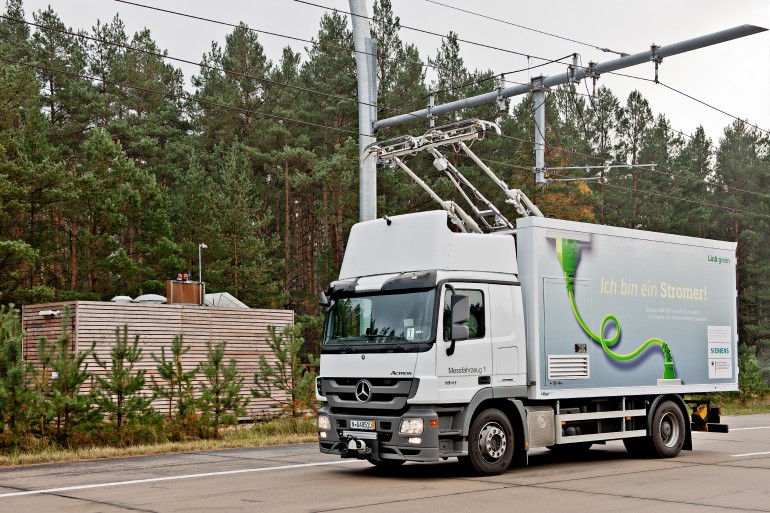
Heavy goods vehicles have been fitted with a brand new pantograph - the second part of the concept - with an intelligent control system that can either automatically connect to an overhead wire upon detection by a built-in scanner or be manually controlled by the driver. Installed above the driver's cabin, the system is said to be capable of detecting the relative position of the overhead contact wire to the pantograph and counterbalances any lateral movements of the truck via active horizontal adjustment.
The test vehicles have also been retro-fitted with diesel-electric power trains, where they are always powered by an efficient electric motor but when in diesel mode, the vehicle's engine powers a generator, which in turn drives a downstream motor and turns the cardan shaft. When traveling under eHighway electric power, the vehicle is driven by the electric motor only. Siemens says that the driver is not aware of the transitions between different drive modes.
The field trial in Germany is reported to have confirmed full performance potential, independent of weather, conditions and load. The concept proved to be at least as flexible as existing fuel-based road freight transport solutions thanks to the maneuverability of the mobile pantographs, with reduction in carbon dioxide, nitrogen oxide, soot and noise pollution and added fuel efficiency benefits. Keeping up with the flow of traffic doesn't appear to have been a problem either, with speeds of up to 90 km/h (55 mph) being reached without difficulty under direct transmission of electric power.
Moving beyond the proof of concept test phase, schemes for the electrification of ports and cargo centers are already being considered but the solution has great potential for expansion to inner city roads in much the same way as streetcars/trams, and of course onto major transport routes. Naturally, such an infrastructure could also readily support the electric power needs of pure battery electrics, vehicles with range extenders, or those fitted out for compressed natural gas.
Thursday, June 21, 2012
Aston Martin revives the Vanquish nameplate
The Vanquish name is to return to the Aston Martin stable with
deliveries of the 183 mph, £190,000 (US$299,000) sports car expected in
late 2012. There's a lot of the limited edition £1.2m One-77 supercar in
the recipe, with a 565 bhp 6.0-liter V12 driving through a Touchtronic
six-speed automatic gearbox, and 0-100 km/h acceleration in 4.1 seconds.
The Vanquish is the latest evolution of Aston Martin’s visual language, with styling cues such as the new waist, elongated side strakes and LED rear light blades all derived from the One-77. It's not entirely unexpected, with a teaser video earlier this year indicating pretty closely what was in store. Project AM310 was shown in Italy at the Villa d'Este and has now emerged as the Vanquish.
The original Vanquish was unveiled at the 2001 Geneva Motor Show and was produced until 2004 replaced by the Vanquish S until production ceased in 2007. Its rise to household recognition came partially from being James Bond's car in the film "Die Another Day" with the DBS which replaced it following up as the 007 car in the remake of "Casino Royale."
The New Vanquish
The new Vanquish is very well detailed. One of the design highlights of the is the new Aero Duct on the rear boot lid - it counteracts lift at the car’s rear when traveling at speed, but the end-result is so gorgeous that it'll win a lot of hearts in the automotive enthusiast community for its aesthetics.If you're thinking that a big V8 signifies old school, the Vanquish has carbon fiber body panels on the car is constructed from carbon fiber with its torsional rigidity up 25 percent.
Aston Martin Chief Executive Officer, Dr Ulrich Bez said of the new car: “Today’s Vanquish is the ultimate expression of Aston Martin design ethos, engineering innovation and technical ability. It offers luxurious, continent-crossing capability and pure driving excitement without compromise.
“The new Vanquish mixes beautiful design with impressive technology such as the superb new infotainment system. This is the latest incarnation of everything we know, informed and developed from One-77. It is the ultimate Super Grand Tourer – confident and assured – and is the newest representation of Power, Beauty and Soul.”
Of course when you're shopping in this price range, you'll be considering the Ferrari F12Berlinetta, the McLaren MP4-12C , Bentley Mulsanne, Rolls-Royce Ghost, and you'll save if you settle for an AMG Mercedes-Benz SLS Coupe or CL65 Coupe.
Saturday, May 26, 2012
It's been about two years since Tesla and Toyota announced a partnership, and we're now seeing the first major fruit of their labor. The RAV4 EV, the modern market's first all-electric SUV, will land in dealerships in the coming months. Toyota used the 26th annual Electric Vehicle Symposium in Los Angeles to launch the production model.
So far, the electric vehicle market has been dominated by small cars like the Nissan Leaf and Mitsubishi i-Miev. The RAV4 is the first product of the modern EV era to package electric technology in a larger SUV package. According to Toyota, the RAV4 EV doesn't even sacrifice space for its electric components, touting the same available cargo capacity as the standard gas-powered RAV4.
As anyone that follows electric cars knows, there are two things that really hold the market back: range and price. The RAV4 is definitely no exception. In fact, at a starting price of US$49,800 (before delivery fees), it's more a poster child for high EV premiums. The RAV4 EV's range, which has yet to be confirmed by the US Environmental Protection Agency, is estimated at 100 miles (161 km) - pretty much the industry standard at this point.
The RAV4 EV may not offer the range of its gas-powered sibling, and its front-wheel-drive layout won't give you the same utility as the gas model's available four-wheel drive, but Toyota says that other performance metrics are quite comparable. The RAV4 EV has two driving modes - Sport and Normal. Sport mode opens up a 0-to-60 mph (97 km/h) time of seven seconds and a 100 mph (161 km/h) top speed. Normal mode sacrifices some of that performance to better direct battery power toward driving range. The154-hp powertrain behind those numbers was developed by Tesla.
Toyota partnered with Leviton for the RAV4's officially approved charging equipment. With the available 240-volt charger, the RAV4 will get fully juiced up in about six hours. It will also come with a 120-volt charge cord for use as a back-up.
Like the demonstration vehicle, the production RAV4 EV's styling includes subtle distinctions from the standard RAV. It has a new front-end, new LED headlamps and taillamps, electric badging, redesigned side mirrors, and a distinct rear spoiler in back. Many of those changes were aimed at aerodynamically optimizing the RAV4's body to get the most range and performance. Toyota says it has the lowest drag coefficient of any SUV.
Toyota will launch the RAV4 in California by the end of the summer. Los Angeles, Sacramento, San Francisco and San Diego will serve as the initial launch markets. It plans to sell approximately 2,600 models over the first three years.
It's good to see the electric car market getting more diverse, but for the kind of money that you'd need to invest in a RAV4 EV, you might be better off waiting for the Tesla Model X, which will have better performance, more range and an all-wheel-drive option.
Volvo claims World Hybrid Truck speed record
You will see a lot of stories around the web this week indicating that Volvo’s "Mean Green" truck has established a new world speed record. Volvo neglected to mention in the press release that it was the world hybrid truck speed record it had attained and hundreds of sites regurgitated the release verbatim without thought. The world land speed record is 1227 km/h - the Volvo ran about 1000 km/h slower than that.
While the Mean Green's 2100 bhp D16 diesel/electric powertrain generated an impressive (for a truck with all that frontal area and the cD of a housebrick) 236.577 km/h (147.002 mph) flying kilometer, that's a long way short of the Thrust SSC's supersonic 1227.986 km/h absolute land speed record, the wheel-driven record of 737.794 km/h, the diesel-powered record of 563.995 km/h, the electric-powered record of 495.140 km/h and indeed, not much faster than the wind-powered land speed record of 202.9 km/h set by Ecotricity Greenbird in 2009. What is impressive is that Mean Green runs the same Volvo hybrid drive system being used by hundreds of Volvo buses throughout the world, including London's double-decker buses. The truck also took the Standing Kilometer record for trucks at an average 153.252 km/h (95.245 mph), an enormous feat of acceleration for the motor which produces 6,780 Nm (5,000 lb-ft.) torque, of which, 1,200 Nm (885 lb-ft.) of torque comes from the electric motor. The electric motor is responsible for 200 bhp of the 2100 bhp total. The speed record attempts were sanctioned by the United States Auto Club, an extension of the Fédération Internationale de l'Automobile (FIA), motoring’s international governing body. The new world records are subject to FIA recognition, which will occur in about 30 to 60 days. Mean Green established its first records of 218.780 km/h (135.943 mph) in the flying kilometer in June 2011 at Hultsfred Airport in Sweden. Though Mean Green’s aerodynamic body design bears little resemblance to a normal Volvo freight-carrying tractor unit, the truck is comprised almost entirely of production components from the Volvo vehicle family, including a Volvo VN cab and frame.
Tuesday, May 15, 2012
Ford considers injecting old money into car manufacture
Once the cornerstone of economic prosperity, the passing of paper money from one hand to another is definitely on the decline in our modern digital age. Yet there are obviously lots of folks who still use cash, as evidenced by the eight to ten thousand pounds (3,628 - 4,535 kg) of crumpled and tired-looking paper currency that's said to be shredded every day in the U.S. alone, before being compressed into bricks and then buried or burned. That's a shocking waste, and car giant Ford appears to agree. As part of an ongoing effort to find sustainable alternatives to petroleum-based vehicle components, the Michigan-based multinational automaker is looking to re-use retired dollar bills in the manufacture of trays and bins, in the same way wheat straw is currently used in the Ford Flex.
Ford's research into green alternatives to petroleum-based automotive components began in the early part of this century, when a barrel of oil was priced at US$16.65. Soybean farmers approached the company in search of new ways to make use of an abundant U.S. harvest and while early attempts at creating soya-based foam were less than successful, Ford's researchers persevered and after five years managed to successfully meet the company's strict quality standards. Soya-based foam is now used for cushions in all North American vehicles, saving around five million pounds (2,268 metric tons) of petroleum every year.
The 2013 Ford Fusion is said to contain the equivalent of a little more than two pairs of blue jean denim used for sound dampening material, the new Escape features door bolsters made from kenaf (a tropical plant in the cotton family) which saves 300,000 pounds (136 metric tons) of oil-based resin annually, and wood fiber is being used in the doors of Ford's new Focus Electric. Plastic bottles are finding their way into seat fabric and carpeting, and cotton from t-shirts, sweaters and denim is being re-used in the manufacture of dashboards.
The cost of oil has risen dramatically in the years since Ford's early experiments - with the price per barrel reaching a staggering US$109.77 earlier this year - and prompted the company to intensify its search for sustainable, renewable materials.
Last year, we revealed that Ford researchers had turned their attention to chocolate to produce lighter plastic parts for the company's vehicles, now they're looking at dandelions as an alternative to rubber, coconuts coir to reinforce plastics, corn and sugar cane for alternative plastics and, as mentioned earlier, retired U.S. currency.
The company says that these readily-available, sustainable and renewable source materials may never actually be used in a future Ford product but the fact that such things are now being given serious consideration as sustainable alternatives for the 300 pounds (136 kg) of oil-based plastic found in an average vehicle - as opposed to being, at the very least, frowned upon - is a very good sign indeed.
Wednesday, May 9, 2012
Dual-mode transport - the trend accelerates
One of the many interesting trends evident at Auto China in Beijing last week was the ongoing development of vehicles offering dual modes of transport - cars containing another transportation device of some sort. China is facing all the same pollution and congestion problems as the rest of the world, but on a much greater scale. For Chinese consumers it seems that having a primary vehicle contain a smaller electric "Transportation Appliance" offers a more comprehensive transportation solution.
The transportation gap
As car ownership grows rapidly in China, India, Russia, South America and Asia in general, congestion grows too and parking in city centers becomes prohibitively expensive. Getting from A to B often involves mixing transportation modes, and a car will increasingly only get you part of the way to your destination in many countries in the world - particularly in China where the number of electric two-wheelers on the street is already overwhelming, and the mainstay of China's personal transportation spectrum.
Consider this! In 2009 Chinese consumers purchased 13.6 million cars to become the world's largest automobile market. China had a national carpark of electric two-wheelers of 120 million in 2010 and electric scooters have been available for only the last seven or eight years, indicating sales averaging at least 15 million a year during that period.
That means the electric scooter has been the most prolific form of motorized personal transport in China by a fair margin for several years. It's hence not hard to see why Chinese manufacturers might be wanting to create a bridge between two and four-wheeled transport. Because two-wheeled transport is more popular than four-wheeled right now, two-wheelers are cheaper to run and buy, and they're a perfect adjunct to a car, or for want of an apt comparison, the "Mothership."
A larger vehicle, particularly an electric vehicle or hybrid electric vehicle with large capacity battery, can ensure your miniature EV is charged and ready to go when called upon.
China will have 150 million electric bikes on the road by 2015. Interestingly, the numbers suggest that electric bike sales in China are on the wane - the forecasts add 30 million e-bikes over the five years from 2010 to 2015.
I think this grossly underestimates the numbers of electric two-wheelers currently being sold.
Please note - if you live in America, you probably won't have experienced the urgent needs of these countries to solve congestion problems - America's geography is unique and quite different to most countries.
In terms of traffic flow, two wheelers offer a much more fluid and dense traffic flow than cars, and unless radical surgery is performed on Chinese roads, or complete infrastructures such as in General Motors' proposed EN-V mass personal transport concept, Chinese roads will come to rely on the mixing of high proportions of motorcycles and other small EVs to overcome the congestion.
In the future, the number of transportation options most humans use in any given journey is expected to rise - cars will only be part of the solution as new forms of both public and personal transport appear such as the electric scooter, the Segway, Toyota's iREAL, and a host of two-, three- and four-wheelers which fill the gaps between cars and public transport, public transport options increase, and the entire mobility spectrum is used.
Aston Martin gets personal in Beijing
While there were no totally new offerings from Aston Martin at Auto China 2012, the British luxury automaker took the opportunity to showcase its personalization capabilities by unveiling three "Year of the Dragon" special editions. The decked-out DBS Volante, Virage Coupe and V8 Vantage S Coupe on show in Beijing are part of the company's "Dragon 88" edition which will be limited to, you guessed it, 88 customized sports cars.
Aston Martin says that each of the 88 cars will feature "bespoke details that celebrate the mystical qualities of the dragon symbol, synonymous with power, strength and good luck in Chinese folklore." This detailing includes golden dragons embroidered on the headrests and 24-carat gold coated Aston Martin wing badges. The cars also get a special paint job to "chime with traditional Chinese art and imagery."
The customization doesn't extend to performance upgrades, but perhaps to soften this blow, Aston Martin showed the 7.3-litre, carbon fiber-packing One-77 supercar alongside the "Year of the Dragon" offerings.
Aston Martin wasn't alone in its efforts to impress the locals in Beijing (Smart and Jeep also showed dragon-themed cars) and is pushing to rapidly expand its distribution in the region.
“We are investing significantly in the Chinese market throughout 2012 and beyond," says Aston Martin's Global Sales Director Andy Gawthorpe. "Today Aston Martin operates nine dealerships in the region, with 11 additional showrooms planned to open in China this year alone. China is on course to become Aston Martin’s third biggest market.”
Sunday, May 6, 2012
Audi unveils first luxury-class e-tron concept car in Beijing
Audi has added to its e-tron series of electric and hybrid concept cars with the unveiling of the A6 L e-tron concept at 2012 Beijing Motor Show. Joining the Frankfurt, Detroit, A1, Spyder and A3 e-tron models, the A6 L e-tron concept is the company’s first luxury-class e-tron concept vehicle. Based on the new A6 L, it is a plug-in hybrid that boasts an electric-only driving range of 80 km (49.71 miles).
Audi chose Beijing to unveil the A6 L e-tron concept as the A6 L, which is produced at its Changchun plant in a joint venture with Chinese automaker, First Automobile Works (FAW), is the company’s bestselling model in China.
The concept vehicle combines a 2.0 TFSI engine outputting 155 kW (211 hp) and an electric motor generating a peak output of 70 kW (95 hp). It can be driven powered only by the internal combustion engine, only the electric drive, or in hybrid mode, with a hybrid control module choosing the best mode to maximize driving range.
An energy flow indicator on the instrument panel lets the driver know the current operating mode and which hybrid drive components are currently active. The display screen also shows the average fuel economy and amount of energy recovered over five-minute intervals.
Audi has also replaced the tachometer with a powerometer that indicates the total power of the drive system on a scale of zero to 100 percent. An auxiliary instrument displays the current charge state of the liquid-cooled lithium-ion battery that is located in a collision-protected space at the rear of the vehicle.
In electric mode, the vehicle boasts a range of 80 km (49.71 miles) at a constant speed of 60 km/h (37 mph). This is a big step up from the 3 km (1.86 mile) electric-only range offered by the electrified drive systems found in the company’s current Q5 Quattro, A6 and A8 hybrids.
The concept car has a body that is around 10 percent aluminum and is identical to that of the A6 L business sedan, with a 3.01 m (9.88 ft) wheelbase, 5.02 m (16.47 ft) length, 1.87 m (6.14 ft) width, and 1.46 m (4.79 ft) height. A single-frame grille with slender cross-bars and nearly-covered air intakes that are common to all e-tron models visually differentiate it from the production A6 L.
Audi says the use of aluminum results in a body that is around 15 percent lighter than comparable all-steel designs, and that all future Audi models will be lighter than their predecessors. This will be achieved through the use of combinations of lightweight materials, including carbon fiber-reinforced polymer (CFRP).
As the first luxury e-tron concept, the interior of the vehicle boasts all of the A6 line’s luxury-class features, including seat ventilation and massage functions, Bose surround sound system, deluxe air conditioner with air ionizer, and MMI navigation plus navigation system with touchpad character input and the ability to recognize 29,000 Chinese characters.
Driver assistance and safety systems include active lane change assist, parking assist, night vision assistance that highlights detected pedestrians, and a pre sense system designed to reduce the severity of accidents.
Although Audi designed the A6 L e-tron concept specifically around Chinese requirements, there’s no word on whether the car will make the leap from concept to production vehicle there or in other markets. However, the company has revealed the e-tron Frankfurt – also known as the R8 e-tron - will get a short production run later this year, while the A3 e-tron will enter full production in 2014. Audi says these will be followed by other “New Energy Vehicles.”
Saturday, May 5, 2012
Ferrari updates its HY-KERS hybrid system for upcoming Enzo successor
In addition to recently showing off its brand new F12 Berlinetta in Beijing, Ferrari brought along the latest version of its HY-KERS hybrid system. The system has been tweaked for a mid-rear engine layout.
A road version of Ferrari's F1 technology, the HY-KERS system was originally demonstrated on the 2010 599 HY-KERS lab vehicle. At the time, it was worked into the 599 GTB Fiorano's front-engined layout.
It's believed that Ferrari will debut the commercial version of the hybrid system on the upcoming Enzo successor, codenamed the F70. That model should surface sometime early next year, and the updated HY-KERS system shows how Ferrari will power the new flagship.
Like the Enzo before it, the F70 will carry its V-12 engine amidships, so Ferrari has reworked the HY-KERS within that framework. The new HY-KERS connects a V-12 engine and electric motor to a dual-clutch transmission. A second, non-powertrain electric motor is used for powering auxiliary electronics like power steering and air conditioning. Both motors receive power from a battery pack that can be mounted in a variety of ways, to be determined by the car's final layout.
Ferrari says that the hybrid system carries the dual function of increasing power and decreasing emissions. It hasn't provided any output numbers, but rumors have it that the system will add up to 120 extra horses over the V-12's ~ 800 hp. When accelerating, the main electric motor delivers extra power through the dual-clutch gearbox. When the driver hits the brakes, the motor turns into a generator, transforming brake energy into electricity to recharge the batteries.
Ferrari states that the HY-KERS system has officially stepped beyond the experimental stage and development will start within the coming months. It hasn't announced a specific debut date for the F70, but has indicated that January's North American International Auto Show and March's Geneva Motor Show are possibilities.
Friday, May 4, 2012
Cadillac road testing semi-autonomous “Super Cruise” technology
While much work is being done to bring autonomous vehicles to the roads, the closest most of us have yet got is cruise control, which has actually been around since the 1950s, appearing as “Auto-Pilot” in 1958 Chryslers and Imperials. Now Cadillac is looking to update things with road testing currently underway on a semi-autonomous technology dubbed “Super Cruise” that offers fully automatic steering, braking and lane-centering in highway driving – under certain conditions.
The Super Cruise technology relies on a combination of radar, ultrasonic sensors, cameras and GPS map data to provide semi-autonomous driving capabilities on the highway even in bumper-to-bumper traffic. The key to this is the use of lane-centering technology that uses forward-looking cameras to detect lane markings, together with GPS map data to detect curves and other characteristics in the road.
Super Cruise builds on many technologies already available as part of its Driver Assist Package in the 2013 Cadillac XTS and ATS sedans that come together to provide what Cadillac claims is 360-degree crash risk detection and enhanced driver assist features. These include rear automatic braking, forward collision alert, full-speed range adaptive cruise control, safety seat alert, automatic collision preparation, lane departure warning and side blind zone alert.
Cadillac hopes to have Super Cruise technology ready for its vehicles by mid-decade, but even when it does appear drivers won’t be able to catch some shut-eye on long trips. As the technology is limited by external factors such as weather conditions and the visibility of lane markings, drivers will have to take the wheel when the system can’t gather reliable information.
Peugeot unveils compact Urban Crossover Concept in Beijing
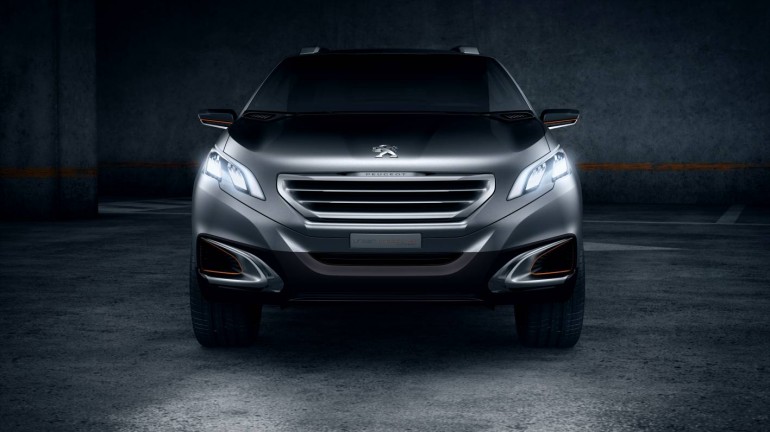
In the wake of the Bentley EXP 9 and Lamborghini Urus showings, yet another SUV has been unveiled at the 2012 Beijing Motor Show in the form of Peugeot’s Urban Crossover Concept. Essentially a refinement of the SXC Crossover Concept that appeared at the 2011 Shanghai Motor Show, the new concept vehicle is a compact SUV designed primarily for urban driving.
Leveraging its expertise in the compact car segment, Peugeot’s Urban Crossover Concept measures just 4.14 m (13.58 ft) long and 1.74 m (5.71 ft) wide. There are no details as to what lays under the hood, but the front end features the company’s new floating “smiling grille,” while the roofline was inspired by the RCZ coupé. The RCZ was also the inspiration for the double-bubble roofline and the aluminum spoiler mounted on the lip of the rear hatch.
The vehicle’s headlamps, coupled with the grille, are designed to give the car a “feline” look, which extends to the rear LED’s that light up in three lines to represent three floating claws of the company’s signature lion.
For those looking to escape the city, where the vehicle would most likely spend most of its time were it to enter production, the Urban Crossover features a raised body and large wheels.
Peugeot hasn’t revealed any plans to take the Urban Crossover Concept into production, but given the market popularity of the compact SUV segment and the fact that this latest concept features many of the same style cues seen on the SXC concept, signs are good that something similar will hit the market in the future.
Thursday, May 3, 2012
Mercedes-Benz Viano Vision Diamond - chauffeured luxury
Apart from the Super-SUV trend at today's Auto China 2012 opening, the other distinct trend was towards bespoke or limited edition exclusivity in the luxury automobiles on display. China is not yet the world's biggest luxury marketplace, but it soon will be much bigger than anything prior.
China has 125 cities with more than a million people (America has nine) and as the country has become the manufacturing powerhouse of the world, many people have created extraordinary wealth in all of these cities.
Important people with new-found wealth need appropriate wheels and for a man-about-town businessman, Mercedes-Benz has crafted the Mercedes-Benz Viano Vision Diamond - the luxury van as a chauffeured vehicle.
The obligatory high quality paint and gold pin-striping and the words Mercedes-Benz emblazoned in gold mark the Vision Diamond as much more than a delivery van on the outside.
The interior is the most relevant bit though, transforming from a business setting to a comfortable relaxation space and back at the touch of a button.
One of the areas of development on show in Beijing across several manufacturers was the control of sunlight using vario-chromatic technology in the window and roof glass so that its opaqueness varies with the microcurrent applied. The windows of the passenger compartment are all equipped with the Mercedes-Benz version of variable glass (called the Magic Sky Control system), which enables passengers to change the interior lighting conditions.
The system can ensure complete privacy for business discussions as the glass partition between the chauffeur and the passenger compartment can be blacked out too.
The chauffeur’s area is completely black in color and the passenger compartment is entirely in porcelain white, from the carpet and the seats to the safety belts and the ceiling.
The passenger seats come with heating, cooling, and massage features as well as calf benches and footrests.
Between the seats are cup holders and Champagne glass holders for the model’s silver Champagne flutes, which appear at the push of a button. The side paneling has five bottle holders as well. The Champagne bottle retainer is equipped with a cooling system. Eight diamonds embedded in the interior trim refer to the lucky Chinese number eight and underscore the vehicle’s luxurious atmosphere.
The controls for everything in the rear of the vehicle are operated by two iOS devices (iPad 2 or iPhone 4) including the optional Bang & Olufsen “BeoLiving Viano” sound system, interior lighting and the sound system for the model’s 40-inch screen.
The 40-inch screen is located on the partition to the chauffeur's area and is raised and lowered with the partition. An intercom can be used for communication between the driver and passenger.
Tuesday, May 1, 2012
Mercedes-Benz Sprinter Van outfitted like a private jet for New York Auto Show
Mercedes-Benz cars are pretty plush, luxurious vehicles, although even the most optioned-out S Class really can't compete with the pure comfort and style of a private jet ... but this Mercedes van can. The JetVan Sprinter was specially outfitted by Ventura, California-based Becker Automotive Design for display at the New York Auto Show. It brings a level of luxury that not even the average limousine can offer.
The spacious interior, which was purpose-built to emulate the interior of a private aircraft, is appointed in Townsend leather with Golden Birdseye Maple trim. There are four reclining, first-class-style leather seats with all kinds of legroom. Those seats are outfitted with adjustable leg supports, lumbar supports, massage systems and heating.
The electronics package puts most home entertainment systems to shame. A center-mounted, 40-inch high-definition Runco LCD TV is assisted by a 1,300-watt 7.1 channel speaker system drawing its sound waves from multi-channel McIntosh amplifiers. If work is more your thing, the Becker Sprinter has a 500-GB on-board computer with wireless 4G connectivity. A set of fold-out writing tables allow you to use a notebook computer or actual notebook. All functions – seats, entertainment, computers, lighting, blinds etc. – are controlled by six-inch Creston touchscreens located on either side.
In terms of the van itself, the Sprinter is powered by a 3.0-liter BlueTEC diesel engine. The engine is made cleaner by way of a Diesel Exhaust Fluid Injection (DEF) system that cuts down nitrogen emissions.
"Many of our clients view the Sprinter as making an environmental statement," said CEO Howard Becker. "They understand the significance and the fuel efficiency of a clean diesel engine, and their drivers appreciate being able to idle for an extended time while they wait outside a studio."
We're not too convinced that a huge van loaded with heavy equipment, all kinds of power-sucking electronics and only four passengers is a real environmental statement, but who wouldn't want to take a road trip in the back of this thing.
Becker works closely with its clients to design vans with just the right layout, materials and equipment. Its client list includes notables like Jerry Seinfeld, Will Smith and Bruce Springsteen. The company often works to duplicate clients' actual private aircraft features. It offers several different floor plans, and options include a couch, refrigerator and hidden toilet.
Becker lists pricing for its JetVans between US$200,000 and $450,000, but it doesn't specify whether that includes the cost of the base vehicle or just the upgrades.
Subscribe to:
Posts (Atom)