Mozilla Firefox
Sameera's Blog
Share on Myspace Delicious Save
Showing posts with label Solar Power. Show all posts

Friday, June 29, 2012

Form follows function for Barcelona's Solar House 2.0


It's rare to see a building's form so adapted to maximizing renewable energy potential as is the case with the Endesa Pavilion, Solar House 2.0. Not content with a roof completely covered in photovoltaic panels, the designers at the Institute for Advanced Architecture of Catalonia (IAAC) led by Rodrigo Rubio have covered the building's south facade with protrusions supporting additional solar panels, which are angled optimally for harvesting energy from the sun.


In a neat twist the same protrusions act as solar barriers during summer when the sun tracks a higher course across the sky, but let sunlight directly in during winter. In this way solar heat gain is limited to the times of year when it's desirable. It's this interplay between maximizing PV gain, blocking solar penetration in summer but allowing it in winter that accounts for the south facade's diverse features: features which were generated by specialized software having been fed all of the geographic parameters.

Software was also intimately involved in the building's fabrication. A computer numerical control (CNC) wood router was used to fabricated pieces from the buildings CAD design data in a process similar to 3D printing, as seen in the WikiHouse we looked at recently.


The 154 sq m (1,658 sq ft) building was commissioned by energy company Endesa, and forms a public information center and "control center" for the Smart City Expo.

As for the productivity of the solar cells, we tracked down a clue on Endesa's website, which refers to "an average daily consumption of 20 kWh and an estimated output of 100 kWh." One interpretation for this is that on average the building generates 100 kWh of electricity but only uses 20 kWh, and consider that there is in the order of 150 sq m of photovoltaics on the roof alone, this doesn't seem beyond the realms of the possible.

The building itself is made almost entirely from wood, which the IAAC suggests is fitting for a building nicknamed Solar House 2.0. "We built a solar house with solar material," the IAAC writes on its blog. "Wood is a living material that grows in the sun. It is an inexhaustible material produced in culture. Is a soft, accessible, easy to work, adapt and join. It’s a warm material, which provides high thermal insulation."

The building stands at Barcelona's Moll de la Marina and will open to the public for Smart City Barcelona, taking place this coming November.


Sunday, May 27, 2012

iPad protective cases use light to extend functionality and battery life

Last April, Logitech partnered with ZAGG to release a rather smart iPad case with built-in physical keyboard. The company has now announced a new book-style case for Apple's tablet where the power for the included Bluetooth keyboard comes from batteries juiced up by built-in photovoltaic panels. The Solar Keyboard Folio won't help an iPad last any longer, though. Fortunately, Wireless NRG has developed a tough extended battery case for the iPad that also packs light-soaking cells on its flap that can keep the protected tablet going for up to ten days. The panels on both cases don't just rely on direct sunlight for power, as they can also take advantage of indoor light too.
Logitech says that when the NiMh batteries of its new Logitech Solar Keyboard Folio are fully charged, the Bluetooth 3.0 keyboard will be operational for two years (based on an average use of two hours per day) even if its dye-sensitized solar cells never get access to any light during that time. The 64 (U.S.) / 65 (EU) keys have 1.5 mm of key travel and the case provides two viewing angles for either typing or viewing comfort.
Compatible with the second and third generation of iPad, the 16.8 x 0.7 x 9.96-inch (428 x 17.8 x 253-mm) book-style case offers front and back protection for the enclosed iPad, auto wakes the tablet when it's opened, and places it in sleep mode when closed. It's available this month for US$129.99. The Kudocase from Wireless NRG trickle charges the built-in 4mm thin 10,000mAh batteries when the photovoltaic ink panels are exposed to either indoor or outdoor light sources, which in turn tops up the iPad's battery at the required voltage. The company says that the case essentially extends the iPad's ten-hour battery life to an impressive 24 hours of continued use. Based on the same two hours per day average as above, it's claimed that the case can give up to ten days of tablet use before needing some charging attention. The Kudocase can also be used to juice up other devices in addition to the iPad courtesy of a USB charging port. An included HDMI 1.3 adapter caters for watching content from the tablet on a connected big screen TV, monitor or projector.
As well as extending the iPad's battery, the Kudocase also affords the tablet some protection thanks to a hard shell outer housing made from biodegradable corn grain. It benefits from a number of different viewing angle possibilities and features a useful whistle locator which will beep when the user, well, whistles (although the feature can be turned off to avoid accidental activation). Users who simply can't wait around for sufficient light to fully charge the high capacity battery pack will be pleased to find a mains power lead supplied with each case. There's a Kudocase version for each of generation of iPad and a number of colors to choose from. It's available now for US$189.95.

Sunday, May 13, 2012

AirHotel's hanging rooms lift lodging out of the ordinary

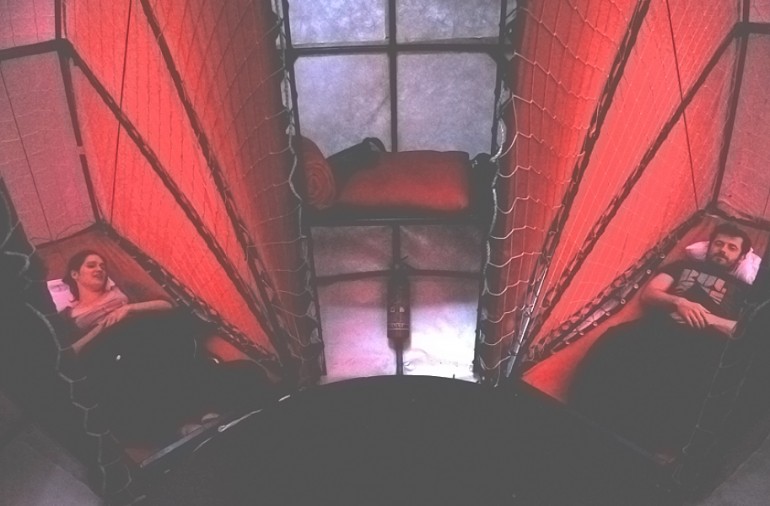
Looking for a place to stay that's sustainable, fun and suspended? The one-of-a-kind, mobile AirHotel, designed by a group of Belgian artists, may be just the ticket. Made from recycled materials, the quirky hotel's six elevated or hanging rooms are each unique in their own way and all come with an unusual form of room service that ranges from a love song to a disco party.
The solar-powered "Wellness Machine" is the nerve center for the unusual traveling complex (actually more motel than hotel) and houses reception, a bar and lounge, a sauna and the breakfast service. Guests stop there first before being whisked off for a tour of the entire facility. The largest accommodation is the canvas-covered "Schulp" or "Little Cottage". With room for six guests in three distinct rooms, it floats 6.5 feet (2.5m) above the ground. Although it looks more like a screened in hanging porch than a place to stay, it's probably the least unusual looking of all the various rooms or pods. Perched 13 feet (4m) up, the "Love Nest" does indeed resemble a bird's nest. It's basically a metal frame covered with wood and branches and doubtless gives guests a taste of the bird's life. Fake leather adorns the interior and a large portal window allows natural light to enter.
The "Sterreschijter", likely a challenge for those with a fear of heights, is firmly mounted 19.7 feet (6m) up and resembles an oversized baby carriage. The room's name, best left untranslated in the original Dutch, hints at the great views it affords of the starry night skies. It sleeps two. For VIPs, there's "El Ambassador" - a deluxe cocoon-like pod made of wood with views provided through glass skylights that's accessed by a collapsible/retractable ladder. Securely anchored by four cables, its two guests sleep almost 7 feet (2.5m) up. The "Lotus" is probably the most unusual of all the sleep chambers. When closed, it resembles a giant Japanese lantern but, like its namesake flower, opens into a giant four-petaled flower to accommodate four guests. Also suspended securely from four cables, it floats 13 feet (4m) above the ground.
For those not comfortable with being disconnected from the Earth, the "Night Box" is probably the way to go. The cube-shaped room sleeps two and sits atop a beefy steel frame that hoists it several feet off the ground. Its walls, fashioned from a hodge podge of random recycled materials, hinge down to allow access to the bed inside and the roof opens to bring fresh air and light to the occupants. Reservations are now being taken for the period from May 11-26 when the AirHotel will be located at the Norfolk & Norwich Festival in the UK. Those lucky enough to book a night can expect to pay about US$57 each for a stay that likely won't soon be forgotten.

Thursday, May 10, 2012

New world record claimed for organic solar cell efficiency

German solar technology specialist Heliatek has set a new benchmark for the efficiency of organic solar cells. In independent tests, a new world record efficiency of 10.7 percent was achieved for the company's latest tandem organic photovoltaic (OPV) cells ... and 15 percent may be just a few years away. Organic solar cells are cheaper to produce, lighter and more flexible than traditional silicon-based solar cells, and therefore have a wider range of applications. The downside is that the efficiency rate of OPV cells is still much lower than inorganic solar cells, which are around 15 - 20 percent efficient (though that number is growing). The organic solar tandem cells developed by Heliatek incorporate small organic molecules called oligomers, which are deposited into the thin layers of solar film using a low temperature, roll-to-roll vacuum process. “This enables us to literally engineer the cell architecture to systematically improve efficiency and lifetime.” Says Dr. Martin Pfeiffer, co-founder and CTO of Heliatek. In tests conducted by accredited testing facility SGS, the efficiency of the OPV cell was measured in standard testing conditions which resulted in the record 10.7 percent efficiency on 1.1 cm². The technology also performed well in low light and high temperatures of up to 80 degrees Celsius. The results at low light showed that the OPV cell’s efficiency not only remained constant, but actually increased. The efficiency was 15% higher at an irradiation of 100 W/m², compared with the efficiency measured at 1000 W/m². The tests also found that when efficiency was measured at high temperatures it remained constant. These measurements are surprising when compared to inorganic solar cells, which lose 15 to 20 percent efficiency when exposed to elevated temperatures. Heliatek says these findings add up to a higher harvesting factor under real life conditions than crystalline and thin film solar technologies. “Thanks to the close cooperation between our research teams in chemistry and physics, we are now on our path to achieving 15 percent efficiency within the next few years,” says CEO of Heliatek, Thibaud Le Séguillon. The company’s first roll-to-roll manufacturing line in Dresden which is due to go into production in late 2012.

Tuesday, May 8, 2012

LA opens rooftops for solar energy installations

We're used to seeing solar arrays in desert locations, but this initiative is looking to a new frontier for solar energy - the rooftops of Los Angeles. The recent approval of a Feed-in-Tarriff (FiT) rooftop solar program known as CLEAN LA Solar by the Los Angeles Department of Water & Power opens up over 12,000 acres of potential rooftop space for solar development.
The program targets the rooftops of local homes, businesses and multi-family buildings within Los Angeles to provide rooftops for the installation and collection of solar power. The FiT initiative means building owners will get paid for the energy generated on the rooftop installations. The program differs from a net metering system, which grants owners a retail credit for the portion of electricity generated. "Feed-in-Tariff means getting paid for energy you're generating from your rooftop," explained Adam Jacobson from the Los Angeles Business Council. "Net metering turns your meter back so you get a refund." To create the CLEAN LA Solar initiative, the Los Angeles Business Council created a coalition of roughly 30 non-profit and environmental organizations including CLEAN Coalition, American Lung Association, Tree People and LA Conservation Corps and the Sierra Club. Over the past three years the coalition has commissioned five studies to support an action for the CLEAN LA Solar program. The goal of the program is to build the first 150 megawatts of rooftop solar in the next three to four years with the aim of reaching the 600 megawatts granted in the FiT by 2020. The CLEAN LA Solar initiative works alongside a state mandate requiring local utilities to generate 33 percent of their power from renewable sources by 2020. "The 12,000-plus acres of available rooftop space available for solar could generate as much as 5.5 gigawatts of power Los Angeles," said Jacob Lipa, Los Angeles Business Council Chairman, in a statement. "While getting to a 600 megawatt FiT only takes advantage of a fraction of the total capacity in the city, it's a great start to encourage investment in the city." While other localities have implemented solar programs, the Los Angeles Business Council says the Los Angeles participation is a significant development. "It's the first large U.S. city," Jacobson said. "Los Angeles Department of Water & Power is the largest municipal utility in the country." An increase in solar power equipment in Los Angeles will mean more than a clean energy source. The Los Angeles Business Council sponsored a study conducted by UCLA that found that a 600-megawatt FiT could result in 18,000 green jobs. The program could also bring in as much as $2 billion in investment. Businesses themselves will benefit from long-term cost savings, in which they'll realize a new revenue source in the sale of electricity.
While any building with a rooftop is eligible for the CLEAN LA Solar program, the Los Angeles Business Council has its eye on a number of buildings. "As part of our campaign to advocate for this program we've identified the top 10 rooftops in each city council district," said Jacobson. Many of those viable rooftops aren't in affluent areas. A property study commissioned by the Los Angeles Business Council identified several rooftops with the greatest solar power potential in economically disadvantaged neighborhoods.

Sunday, May 6, 2012

Dow Solar rolls out Solar Shingles in California and Texas

Installing photovoltaic panels is certainly the most common method of generating solar power on a rooftop, and in fact many people might think it’s the only method. There is, however, an alternative – photovoltaic shingles. It makes sense, when you think about it ... why install weatherproof shingles and solar panels separately, if you could get one thing that combined both? Although there aren’t many manufacturers offering such products just yet, this month Dow Solar made its POWERHOUSE Solar Shingles available to consumers in northern California and central Texas.
“The DOW POWERHOUSE Solar Shingle utilizes CIGS-based (Copper Indium Gallium diSelenide) thin-film photovoltaic cells, which have the highest efficiency of available thin-film technologies,” a representative for Dow told us. “This technology has enabled Dow’s breakthrough of a lightweight, durable residential solar application that installs like typical roofing materials. CIGS was also selected because it has a unique ability to perform well in non-standard conditions such as dappled shading, cloudy and diffused light.” Unlike the adobe-inspired curved Solé Power Tiles we’ve covered previously, the POWERHOUSE shingles are completely flat, so they can be worked into existing flat-shingled roofs. This means that as few or as many of the Solar Shingles can be used as desired – the whole roof doesn’t have to be covered with them. Each shingle measures 10 x 22.8 x 0.5 inches (25.4 x 57.9 x 1.27 cm), and can be installed by authorized roofers.
The POWERHOUSE system includes an inverter, the converts the DC current from the shingles into AC that can be utilized in the home. It also incorporates a monitoring system that provides real-time energy production and consumptions figures, via an internet connection. Additionally, Dow can remotely monitor any of the systems itself, to ensure that they’re operating properly. Although exact performance figures aren’t given, the company claims that installations typically offset home electricity bills by 40 to 60%. Currently the product is being rolled out via two authorized dealers in northern California and three in central Texas – three dealers and a builder in Colorado already carry the shingles. While pricing information isn’t available at this time, Dow claims that the cost of an installation should be recovered within the first half of its intended life. The shingles carry a 20-year warranty.

Counterintuitive “LED-type” solar cell breaks efficiency record

When you think of a solar cell, you probably think of something designed to absorb as much sunlight as possible. What you probably don't think of is something that is also capable of emitting light. Nonetheless, that’s exactly what a new prototype device designed more like an LED does, and it recently set an efficiency record for flat-plate single junction solar cells. The cell was created by Alta Devices, a California-based company co-founded by University of California, Berkeley professor of electrical engineering Eli Yablonovitch. Together with graduate student Owen Miller, he worked out a mathematical principle which states that “the better a solar cell is at emitting photons, the higher its voltage and the greater the efficiency it can produce.”
The prototype cell incorporates a gallium arsenide semiconductor. Electrons within that material are knocked loose to flow freely by the energy of photons in sunlight. As the electrons are knocked loose by the existing photons, other photons are generated in the process. So far, that’s the same principle that’s at work in most conventional solar cells. However, the prototype cell is designed to let these new photons escape as easily as possible (in part, via a highly-reflective rear mirror surface), which in turn raises the voltage that it is able to produce. The technology allowed the prototype to achieve an efficiency of 28.3%, which broke the previous record of 26%. Yablonovitch hopes that researchers building on his work may be able to achieve a figure of 30% within a few years. Although the record-breaking device is a flat-plate single junction cell (meaning it is only capable of absorbing light waves within a given frequency), the principle it uses is said to apply to all types of solar cells.

Monday, April 30, 2012

Nomad portable solar lighting system launches during Milan Design Week 2012

Although the 21st Century has seen the dawn of 3D printers, the discovery of new Earth-like planets and seen the rise of the convenient smart phone, approximately 1.5 billion people around the globe remain without access to a stable or safe source of light. Commonly in some of the world's poorest regions, kerosene lanterns are the standard form of night time lighting, which leads to the possibility of fires, explosions, asphyxiation and toxic fumes. Safe and renewable solar lighting presents an obvious solution to this problem and the NOMAD solar lamp has been created for just that.
Developed by the Belgium company O-Sun, the Nomad solar lamp is similar to the Solar Pebble, LuminAID, Sollight and Wakawaka. It has been created primarily to meet the needs of families in developing countries. Gizmag previewed the rechargeable solar lamp during the Salone del Mobile and due to its contemporary design and ecological attributes, we think it could even become a useful accessory around the family home or for camping adventures. The simple lamp design includes a single button for three different lighting settings, offering up to 6 hours of light at full output or 35 hours on the dimmest setting (15-percent output). Protected by a silicon disk, it can easily be placed on the ground without any risk or obstruction of light. Furthermore, the Nomad lamp can easily be suspended above a table or desk, or simply unhooked to transport anywhere just like a classic lantern. The separate solar charger can easily be affixed to walls without requiring tools, or even fastened to the metal frame of a tent by using straps. In addition the lamp can be charged with a USB plug for cloudy days or office use. The solar lamp employs LED technology for a longer lifespan and has been design to resist shocks if dropped or bumped. This is achieved by a shock absorption ring that is placed at the base of the lamp to protect it in the case of an unexpected fall, while also increasing its adherence when placed on a flat surface. The makers chose to use eco-friendly materials such as ABS and recycled packaging with a minimum of ink used, to limit production pollution and offer a better result. The product's green credentials are further boosted with the use of 12 0.18 W high-output LEDs powered by a Li-ion battery . The lamp will be available for the retail market from September 2012 and is estimated to cost €95 (US$125). The O'Sun team is also committed to distributing the lamp to developing countries through true NGO, government support and micro-credit organizations (with a sufficiently reduced price-tag).

Thursday, April 5, 2012

AORA's Tulip solar power system is more than hot air

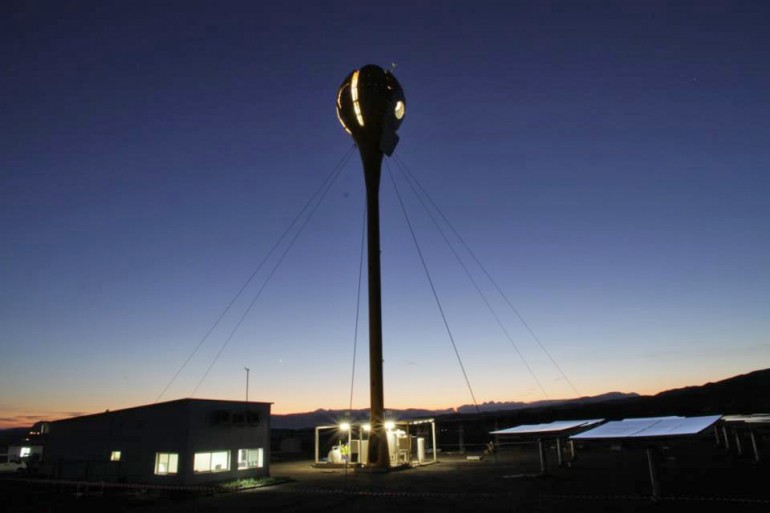
A giant flower has recently sprung up near the southern Spanish city of Almeria. Measuring 35 meters (115 feet) high, the Tulip is the product of Israeli company AORA, and it uses heat from the sun to generate electricity. Work began on the hybrid concentrating solar power technology back in the 80s and the first Tulip pilot plant was installed at Israel’s Kibbutz Samar in 2009. That setup has been pumping electricity into the country’s power grid every year since. The Spanish plant was completed this January.
The scalable, modular system incorporates 52 mirrors – or heliostats – which are arranged on the ground around the base of the Tulip. They turn to track with the sun, reflecting and concentrating its rays onto the plant’s top-mounted “bulb” at all times of the day. This causes the air inside the bulb to heat to temperatures as high as 1,000ºC (1,832ºF). That ultra-hot air is then used to run a turbine generator. The plant has an output capacity of 100 kilowatts-equivalent – reportedly enough to power 60 to 80 homes.
Unlike some other systems that use water, oil or mineral salts as their solar heat-carrying medium, the Tulip uses atmospheric air. It also doesn't require any cooling medium – an important consideration in areas where water is scarce. At night, when there’s no warming sunlight, it can be switched over to generate electricity using fuels such as diesel or natural gas – it can even operate in a hybrid mode when the sunlight is intermittent, using both fuel and solar-heated air at the same time. The Almeria plant took approximately seven months to build, and is designed to operate for at least 25 years. AORA hopes to have additional demonstration plants operational in other parts of the world soon.
The AORA video below provides a run-down on the workings of the Tulip plant.

Wednesday, March 28, 2012

3D solar towers offer up to 20 times more power output than traditional flat solar panels

While we’ve looked at the development of solar cell technologies that employ nanoscale 3D structures to trap light and increase the amount of solar energy absorbed, MIT researchers have now used 3D on the macro scale to achieve power output that is up to 20 times greater than traditional fixed flat solar panels with the same base area. The approach developed by the researchers involves extending the solar cells upwards in a three-dimensional tower or cube configuration to enable them to better capture the sun's rays when it is lower on the horizon. Solar panels placed flat on a rooftop are most effective at harnessing solar energy when the sun is close to directly overhead, but quickly lose their efficiency as the angle of the sun’s rays hitting the panel increases – during the mornings, evenings, in the cooler months and in locations far from the equator. It is exactly in these situations that the researcher’s vertical solar modules provided the biggest boosts in power output. After exploring a variety of possible 3D configurations using a computer algorithm and testing them under a range of latitudes, seasons and weather with specially developed analytic software, the team built three different individual 3D modules and tested them on the MIT lab building roof for several weeks. The results showed a boost in power output ranging from double to more than 20 times that of fixed flat solar panels with the same base area.
By going vertical and collecting more sunlight when the sun is closer to the horizon, the team’s 3D modules were able to generate a more uniform output over time. This uniformity extended over the course of each day, the seasons of a year, and even when accounting for blockage from clouds and shadows. The researchers say this increase in uniformity could overcome one of the biggest hurdles facing solar energy – predictability of electricity supply that currently makes it difficult to integrate solar power sources into the grid. They add that this uniformity, as well as the much higher energy output for a given area, would help offset the increased cost of the 3D modules, which are higher per the amount of energy generated when compared to conventional flat solar panels. While the team’s computer modeling showed complex shapes – such as a cube with each face dimpled inward – would offer a 10 to 15 percent improvement in power output when compared to a simpler cube, these would be difficult to manufacture. In their rooftop tests, the team studied both simpler cube modules as well as more complex accordion-like shapes that could be shipped flat for unfolding on site. This accordion-like tower was the tallest structure the team tested and such a design could be installed in a parking lot to provide a charging station for electric vehicles, according to Jeffrey Grossman, the senior author of the study and the Carl Richard Soderberg Career Development Associate Professor of Power Engineering at MIT. Grossman and his colleagues believe that with the fall in the cost of solar cells in recent years - to the point where they have become less expensive than their supporting structures and the outlay for the land upon which they are placed - makes it an ideal time to examine the benefits of different solar cell configurations. “Even 10 years ago, this idea wouldn’t have been economically justified because the modules cost so much,” Grossman says. But now, he adds, “the cost for silicon cells is a fraction of the total cost, a trend that will continue downward in the near future.” Buoyed by the success of the tests on the individual 3D modules, the team now plans to study a collection of solar towers that will enable them to examine the effects that one tower’s shadow will have on another as the sun moves across the sky over the course of a day. While the team believes its 3D solar cells could offer big advantages in flat-rooftop installations or urban environments where space is limited, they say they could also be used in larger-scale applications, such as solar farms, once a configuration that minimizes the shading effects between towers has been developed. The results of the MIT team’s computer modeling and rooftop testing of real modules appear in the journal Energy and Environmental Science.

Carbon nanotube solar cells point to possible transparent solar window future

Imagine if every window of the 828-meter (2,717-foot) high Burj Khalifa in Dubai was capable of generating electricity just like a PV panel. That's the promise of solar window technology like the RSi and Sphelar cells systems. Rather than using costly silicon for window-based collection of solar energy, Dr Mark Bissett proposes using a very thin layer of carbon nanotubes instead. As part of his PhD at the Flinders University School of Chemical and Physical Sciences, Dr Bissett has developed a proof of concept prototype solar cell that is made up of two sheets of electrically-conductive glass with a layer of functionalized, single-walled carbon nanotubes sandwiched between them. As the nanotube layer is only between 100 - 200nm thick and the two sheets of glass are just 60µm apart, the cell remains transparent - letting some natural light flow through while also collecting energy from the sun. "When light shines on the cell, electrons are generated within the carbon nanotubes and these can be used to power electrical devices," said Dr Bissett. "It's basically like tinting the windows except they're able to produce electricity, and considering office buildings don't have a lot of roof space for solar panels, it makes sense to utilize the many windows they do have instead."
Unfortunately, the cells have yet to be tested outside of the laboratory and work is still needed to improve the efficiency of the technology before being scaled up to an industrial level. Dr Bissett told us that the trade-off between transparency and the ability to harvest light means that even the best cells in the lab are only just approaching 1% efficiency. There is a way around this, but it comes at a cost. "Basically by decreasing transparency you can increase efficiency," explained Dr Bissett. "In comparison, other new solar cell technologies like dye-sensitized solar cells are close to 10% and silicon solar cells tend to be around the 20% mark, depending on the exact technology used to produce them. So work is still needed on increasing the efficiency of our designs to make them competitive, but it is still early days for this technology with many possible research avenues to pursue." Dr Bissett has also successfully demonstrated that the carbon nanotube layer can be spray-coated onto glass, which would allow for larger areas of glass substrate to be functionalized. The next step in the development process is to test the technology in the real world. He believes that if all goes to plan, the new technology could be on the market within the next ten years. "This research is still being pursued by the research group I worked with at Flinders University with Professor Joe Shapter," he said. "There is also work being undertaken to produce flexible solar cells based on graphene, these are of interest for integration into fabrics." Meanwhile Dr Bissett is currently undertaking a post-doctorate at Kyushu University, Japan.

Saturday, March 17, 2012

Pin Lights stake your tent and light up your campsite

Pin Lights are an innovative camping concept from a group of designers. The lights are essentially large pins that take the place of tent stakes. Not only do they keep your tent stable in the wind, but they light up your campsite ... so that wee-hour pee doesn't have to be a life-risking affair. The Pin Light was imagined by a team of designers - Kim Jung Su, Kim Dong Hwan, Yoon Ji Soo and Yoon Jae Sun. The concept is simple but quite practical. Similar to yard lighting, Pin Lights are designed to be stuck into the ground. They presumably have a sharper, sturdier stem than the average yard light, because their job is not only to light up a small area but also to stake the tent out. The advantage is that instead of tripping on a stake or guy line in the dark, both will be clearly visible thanks to the self-illuminating stakes. They serve the same function as the TentLED, but appear better implemented because they identify both the guy line and stake. The top of the lamp is diagonal, so that you can hammer it into the ground without smashing the light itself (though I'm sure it'd be easy to slip). The stakes use solar panels and LED lights to keep things green, and each lamp features an on/off switch and a groove in back to hold the guy line steady. The stakes are fashioned after leaves to "encourage campers to feel united with nature" - save for the whole artificial light blowing up your campsite all night thing. As someone who's tripped on his tent lines and stakes pretty much every time he's camped, I have to say that this could be a very useful design. Camping can be dark, cramped (like when the only flat ground is between two gangly bushes) and disorienting. Having the general area around your tent illuminated would definitely help to make getting to and from the tent in the dark easier and safer. The design could stand to be tweaked a little, though. As much as the Pin Lights could help you see the guy lines, they're so large and bulky, that you're likely to trip on them. From the picture, it also looks like they're excessively bright, meaning you're going to keep yourself and your campground neighbors up all night. The large size also makes Pin Lights pretty impractical for actually staking a tent out. Perhaps if all the camping you do is on soft grass like in the picture, but if you have to start dealing with hard, rocky terrain, good luck pounding something that thick into the ground. A tiny LED or two on a regular, lightweight aluminum stake would be more functional. The system could then work as effectively as any stake, and offer enough light for its purpose without lighting you up like a police officer at a midnight traffic stop. Because there are so many of them, a remote control system might be better for turning them on and off.

Thursday, March 15, 2012

New production process could cut solar cell prices by half

Boosting solar cell efficiency is seen as a key factor in making them more practical, but there is another way of looking at the matter ... if the price of those cells were lowered, we could generate more power simply by using more of them. That’s where Mississippi-based Twin Creeks Technologies comes into the picture. The company has developed a method of making crystalline silicon wafers which it says could reduce the cost of solar cell production by half. Ordinarily, when crystalline silicon wafers are being made for use in solar cells, a chunk of silicon is cut into wafers that are each 200 micrometers thick. According to Twin Creeks, however, only the very surface of that wafer is “active” – the rest is wasted. Much less waste would occur if the wafers could be made thinner, but using traditional production techniques, such wafers would be too fragile to stand up to the rigors of photovoltaic panel production. In Twin Creeks’ proprietary Hyperion process, three-millimeter-thick disks of crystalline silicon are placed in a vacuum chamber, where they’re bombarded with a beam of hydrogen ions. The ion accelerator that’s used is reportedly ten times more powerful than anything else commercially available.
Through control of the voltage of its beam, a layer of ions is precisely deposited on each disk. Those ions proceed to penetrate the silicon, so they’re located just below its surface. The disks are then robotically transferred to a furnace and heated. This causes the ions to expand into microscopic bubbles of hydrogen gas, which in turn causes a 20-micrometer-thick layer of silicon to peel off the surface of each disk. A supportive metal backing is then applied to that layer, and it’s ready for use. The disks can be reused up to 14 times, each time “exfoliating” another layer of silicon. The resulting ultra-thin wafers are claimed to be at least as efficient as their thicker traditional counterparts, yet require 90 percent less silicon to produce. The system can be added to existing production lines, although because less tools are required, production costs should also be significantly reduced. Additionally, the technology can be used with other single-crystal materials such as gallium nitride and germanium. Presently, the technology can be seen in action at Twin Creeks’ commercial demonstration plant in Senatobia, Mississippi. The company intends to license the Hyperion system to existing solar cell manufacturers.