Mozilla Firefox
Sameera's Blog
Share on Myspace Delicious Save
Showing posts with label Technology. Show all posts

Thursday, October 18, 2012

World's biggest multi-touch wall created with two dozen MultiTaction displays


UK-based Engage Production has just stacked 24 MultiTaction Cell displays in the new "Executive Brand Suite" of an un-named City of London client to create the world's largest multi-touch interactive wall. Measuring some 9.9 x 3 m (32.48 x 9.84 ft), including the base, the monster installation's separate screens function as one huge touch display, capable of tracking and registering an unlimited number of simultaneous touch points.


The 55-inch MultiTaction Cell displays that make up the multi-touch interactive wall are manufactured by Finland's MultiTouch Ltd, creators of the Twitter Wall that impressed at CES 2011. This latest gigantic wall of touch forms part of a fully integrated and unique communications facility developed to showcase consumer changes resulting from advances in technology.


As you can see in the following demonstration video, all of the display cell modules used in the creation work as one to register and track an unlimited number of user hands, real world objects, optical markers, and IR pens at a gesture tracking rate of 200 frames per second. Users can also interact wirelessly with the installation using tablets.


In related news, MultiTouch Ltd has also announced the development of a new ultra thin bezel (UTB) MultiTaction Cell display. The bezel at the bottom and left of the new 55-inch unit is just 1.9 mm, and the right and top is 3.8 mm, a significant reduction on the stackable cells used for the monster wall in London (16 mm for the bottom and sides, 17 mm at the top).


The company says that the dramatic size reduction has been made possible by its patented optical imaging technology Computer Vision Through Screen, which integrates touch sensors into the LCD backlight modules. The system boasts the same fast tracking and unlimited simultaneous touch point capabilities as existing Cells, and is also network-enabled.
The new UTB Cell will be made available from the end of this month, with details of pricing available on request. In the meantime, here's a video showing six stacked UTB Cells in action.


Monday, October 15, 2012

Hitachi develops "incorruptible" glass-based data storage technique


Back when compact discs were first coming out, they were touted as being able to store data “forever.” As it turns out, given no more than a decade or so, they can and do degrade. According to an AFP report, Hitachi has unveiled a system that really may allow data to last forever – or at least, for several hundred million years. It involves forming microscopic dots within a piece of quartz glass, those dots serving as binary code.

The idea is that eons after the dots are applied to the glass, a person (or whatever’s around then) should be able to easily read them using nothing more than an optical microscope – no medium-specific device, such as a CD player, will be necessary. Hopefully, the concept of binary code will still be understood.

The current prototype measures two centimeters (0.8 inches) square by two millimeters thick, and incorporates four layers of dots. It currently has a memory capacity of 40 megabytes per square inch, which is roughly equivalent to that of a music CD. The researchers believe, however, that adding more layers to boost its capacity should be doable.
The glass square has withstood exposure to high-temperature flames along with various harsh chemicals, and survived being heated to 1,000º C (1,832º F) for two hours. Not surprisingly, it is also unaffected by radio waves or immersion in water. Of course, glass is breakable, although quartz is known for being particularly hard.

According to Hitachi, the technology may see its first practical use in storing information for government agencies, museums or religious organizations.

This is not the first time that glass has been experimentally used for super-long-term data storage. Scientists from the University of Southampton have been working with monolithic glass space-variant polarization converters, that are read using a laser.

Friday, June 29, 2012

Japan broadcasts Super Hi-Vision signal over the air


Japan's national public broadcaster NHK has revealed that it successfully broadcast a compressed Super Hi-Vision (SHV) signal carrying video at a resolution of 7680 x 4320, 16 times the resolution of regular HD. This is the first time that SHV has been transmitted over the air.

On April 15, NHK successfully broadcast the video via two channels of ultra-high frequency radio from the roof of its Science and Technology Research Laboratories. It was decoded at a distance of 4.2 km (2.6 miles) without error.

Japan's AV Watch reports that, across the two channels used (UHF31 and UHF34), a data transmission bandwidth of 183.6 Mbps was achieved.

Super Hi-Vision is NHK's preferred name for ultra high definition television (UHDTV) at this definition, also known as 8K (or 8K4K). It was one of two UHDTV standards defined by the Society of Motion Picture & Television Engineers in 2007, the other being the lesser 4K (or 4K2K) standard with a resolution of 3840 x 2160, as seen in UHDTVs by Samsung and Toshiba, as well as JVC's 4K2K camera. (JVC's D-ILA projector also discussed at the time supports 8K.) A frame rate of 120 frames per second for both UHDTV standards was subsequently agreed.

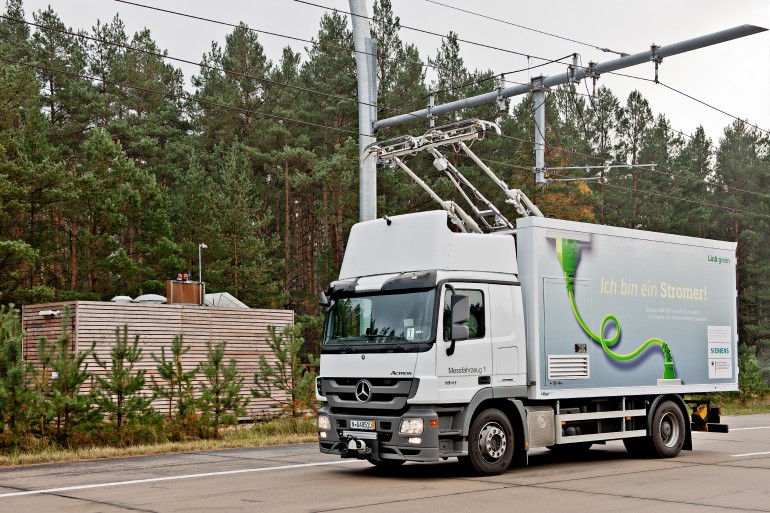
Siemens tests "eHighway of the Future" vision with tram-like overhead cables


With most major auto manufacturers now actively developing electric vehicles, the drive towards a zero emission personal electric transportation future seems very much on the horizon. Road pollution doesn't just come from cars of course, freight vehicles are also major players in choking our highways and byways. Siemens is currently testing a possible solution in Germany that's based on proven railway and tram technology but has been adapted for trucks on roads. Heavy goods vehicles have been fitted with a newly-developed pantograph that can automatically raise to meet overhead cables and transfer electric power to hybrid diesel/electric power trains. Energy recovered from regenerative braking can also be fed back into the system for re-use by other vehicles.


The Siemens eHighway concept announced at the 26th Annual Electric Vehicle Symposium in Los Angeles recently is a two part system. The first involves the rollout of a two pole catenary system along one or more lanes on freight transport routes that caters for two-way electricity transmission and ensures a reliable power supply by feeding the overhead wire via container substations. The substations used in the current test project feature a medium-voltage DC switching system, a power transformer, a rectifier 12-diode array and a controlled inverter (for the feedback of the electric energy generated by regenerative braking).


Heavy goods vehicles have been fitted with a brand new pantograph - the second part of the concept - with an intelligent control system that can either automatically connect to an overhead wire upon detection by a built-in scanner or be manually controlled by the driver. Installed above the driver's cabin, the system is said to be capable of detecting the relative position of the overhead contact wire to the pantograph and counterbalances any lateral movements of the truck via active horizontal adjustment.

The test vehicles have also been retro-fitted with diesel-electric power trains, where they are always powered by an efficient electric motor but when in diesel mode, the vehicle's engine powers a generator, which in turn drives a downstream motor and turns the cardan shaft. When traveling under eHighway electric power, the vehicle is driven by the electric motor only. Siemens says that the driver is not aware of the transitions between different drive modes.

The field trial in Germany is reported to have confirmed full performance potential, independent of weather, conditions and load. The concept proved to be at least as flexible as existing fuel-based road freight transport solutions thanks to the maneuverability of the mobile pantographs, with reduction in carbon dioxide, nitrogen oxide, soot and noise pollution and added fuel efficiency benefits. Keeping up with the flow of traffic doesn't appear to have been a problem either, with speeds of up to 90 km/h (55 mph) being reached without difficulty under direct transmission of electric power.

Moving beyond the proof of concept test phase, schemes for the electrification of ports and cargo centers are already being considered but the solution has great potential for expansion to inner city roads in much the same way as streetcars/trams, and of course onto major transport routes. Naturally, such an infrastructure could also readily support the electric power needs of pure battery electrics, vehicles with range extenders, or those fitted out for compressed natural gas.

Monday, June 25, 2012

Feligan PowerBrick aims to be the one device to power them all


The dramatic increase in the number of devices finding their way into people’s homes has made the humble electrical outlet hot property, with all manner of power-hungry hardware and proprietary port-packing mobile gizmos clamoring for attention. The PowerBrick universal charger from Feligan aims to be your one-stop electricity outlet by virtue of its ability to simultaneously power 11 devices.


The lower front of the PowerBrick - which is aptly named as it is roughly the same size as a housebrick - boasts two 10 W USB ports for larger mobile devices, such as tablets, and two universal 1,500 W sockets for more power intensive household gadgets that Feligan claims will take plugs from any country. However, options for plugging the PowerBrick into the wall are slightly more limiting with the choice of Italian, Sschuko, Swiss, UK and US cords.

Meanwhile, on the top of the device are six customizable connectors to accommodate Micro USB or proprietary connectors for just about any mobile device from any manufacturer (Feligan claims compatibility with over 10,000 devices). Each of the these customizable connector cords is also retractable, allowing the device to be used while it is charging or so the connectors sit neatly along the top of the PowerBrick when not in use. The plugs can also be swapped out and replaced at a later date if you update to a different device after purchasing the PowerBrick.

Previously available in black or white for €69 (US$88), Feligan has just announced the availability of leather-coated PowerBricks in a variety of colors. However, that extra touch of class will set you back €150 (US$192).


Doughnut-shaped Pulpop MP3 speaker made from recycled pulp


Unfortunately, when it comes to sharing digital music with friends, there aren't too many eco-friendly portable speaker options available for the discerning green consumer. When such things do make an appearance, they tend to be acoustic docks made from materials like bamboo (think iBamboo) that simply boost the source audio in a similar way to using an old-fashioned horn speaker, or otherwise get their power from renewable resources (as with the SoliCharger or Rukus, for instance). The Pulpop MP3 speaker designed by Balance Wu and Chin Yang takes a slight diversion from such norms. It's made from recycled paper pulp and uses of vibration speaker technology to amplify the source audio through the surface on which it stands and the hollow space inside the doughnut.


 When FeONIC Technology's SoundBug first appeared in 2002, I was intrigued by the claims of being able to turn any flat surface into a speaker. The reality, however, was something of a let down. The quality of the music that seemed to be coming from windows, mirrors and tables varied considerably from surface to surface but never offered nearly enough bass presence to satisfy my tastes. The Pulpop MP3 speaker is claimed to give crisp, crystal clear and enriched sonic output, which can be felt as well as heard.


As sound doesn't usually travel well through paper, the hollow loop doughnut shape is said to provide enough surface area to distribute sound more evenly and "allow the biggest resonance of vibration to travel 360 degrees throughout the speaker."

The hollow ring is made from eco-friendly paper pulp paste that's molded under high temperature and high pressure. Paper density, temperature control, and even the craftsmanship of those involved in the manual side of each unit's creation can all have an influence on the finished piece. Something that's not mentioned in the specs but is an obvious bonus is that the outer shell will also be biodegradable, although the small amount of internal electronics will need to stripped out before disposal.
Sounds from the digital music player are fed into the electronics via Pulpop's 3.5mm input jack, after which it's said to provide mono output of up to 5-watts RMS. The included 3.7V/600mA rechargeable battery is juiced up via an included USB charging port, although there's no mention of charging times or how long you'll be able to use Pulpop before needing to seek out some power.
It's an attractive and unusual green audio sharing solution but with dimensions of 10.2 x 11.6 x 2.4-inches (259 x 294 x 60 mm), portability could be a problem - particularly as you're not really going to want to take the risk of damaging/denting the paper doughnut by stuffing the speaker into your backpack.

Pulpop is priced at US$56, which is a good deal cheaper than the latest version of the SoundBug, although the latter does offer Bluetooth wireless connectivity and both left and right channel speakers.

Sunday, June 17, 2012

ZeroN system holds a ball wherever you place it, in mid-air


People who saw the 1984 film 2010: The Year We Make Contact might remember a scene in which Roy Scheider, while describing the orientation of the spaceship that he’s aboard, picks up a pen and places it in mid-air in front of himself. While that effect was actually accomplished using a sticky-sided pen and a very clear plate of glass, the same sort of thing is now actually possible – if you’re in the right place, and positioning the right object. The place is MIT’s Media Lab, and the object is a small plastic-coated spherical magnet called ZeroN. Users can physically place it anywhere within a specified three-dimensional block of “anti-gravity space,” then watch as it stays in place when they let it go. It can also move through the air on its own, and even function as a virtual movie camera.


The ZeroN system was created by Media Lab research assistant Jinha Lee in collaboration with Dr. Rehmi Post of the MIT Center for Bits and Atoms, and the Media Lab's Prof. Hiroshi Ishii.
Above its open-air anti-gravity space sits an electromagnet, that can be moved vertically and horizontally via a three-axis motor controller. To the side is a stereo infrared motion-tracking system made with two stock Sony PS3 Eyecam cameras, along with a video projector. A second projector and third camera sit beneath a horizontal translucent screen, that is located on a tabletop underneath the anti-gravity space.

As the user reaches into the space with the ZeroN ball in their hand, the motion-tracking system keeps track of where it is. It relays this information to the motor controller, which moves the electromagnet accordingly. When the user lets go, the magnet will be in such a position that its magnetic field holds the ball in place, right where the user left it. If they then reach in and reposition it, the electromagnet will move with it, to keep it hovering in its new location.


Along with simply keeping the ZeroN where it was left, however, the system can also record its movements and then play them back. This means that the ball could be guided through an aerial routine by hand, let go, and then proceed to repeat that routine on its own.

While these may sound like fascinating parlor tricks, the technology has many potential applications. Using the side-mounted projector, for instance, images can be projected onto the surface of the ZeroN. They will not only stay with it through 3D space, but will also rotate with it as it spins in place. This feature could allow it to be labelled, then used to help visualize physics problems – instead of simply thinking the problems through or looking at two-dimensional computer models, physicists could actually reach in and manipulate models of objects such as electrons by hand.


It could also be used in the field of astronomy to act as a rotating model of a planet, orbiting around a static model Sun.

In fact, it could even play the part of the Sun. If an object is placed on the translucent bottom screen, the bottom projector can be instructed to create a digital virtual shadow for that object on the screen. As the ZeroN is moved above the object, the direction and length of its shadow will change, as if the ZeroN is the Sun.

Additionally, the ZeroN can be assigned the role of a movie camera. In this case, after it has been moved over a grouping of physical models placed below it, a 3D fly-over animation of those objects can be generated, “shot” as if the ZeroN were the camera. This could prove particularly useful to architects, who want to record virtual aerial shots of their hand-built models.

Lee goes into more detail of the possibilities, in the video below.

Wednesday, May 30, 2012

Touchy wearer walks around in darkness until touched by a human hand


If you see what appears at first glance to be a short version of Robocop stumbling through the streets of Tokyo, worry not folks it will likely be Eric Siu or one of his friends using Touchy. The wearer of the head-mounted camera is effectively in darkness until someone touches him, at which point the automated shutters blinding the wearer open briefly and he can once again view the world around him. If the person maintains touch for ten seconds or more, the built-in camera snaps an image and then displays it on a small screen to the rear of the helmet.


"The project adopted the culture of still photo taking, not video recording," said Siu when Gizmag asked why the camera took stills only. "I see the camera as a social device, and the project turns a human into a camera as a suggestion for social healing. To me, a camera has better social capability than a camcorder, since a camera records a particular memorable moment instead of a flow of time. In a group photo, we stand still to wait for the moment to appear, a moment that we are connected in the photograph."
Siu told us that the helmet has a hacked webcam to the front that feeds a 2-megapixel CMOS sensor, producing stills at either 640 x 480 or 1600 x 1200 pixels in JPG format. The storage of snapped images and subsequent display on Touchy's 3.5-inch, 320×240 pixel LCD touchscreen display – on the back of the 6.4 x 8.1 x 9.4-inch (163 x 208 x 239 mm), 2.5-pound (1.17-kg) helmet – are processed using Gumstix hardware.


                                  Details of exactly how the touch sensor actually works are being held back until perfected, but Reynolds told us that the custom-created TouchSwitch "takes advantage of bioelectric phenomena that is observable when two people touch." "The underlying principle is to treat the skin like an antenna which detects the contact made by the encounter of other humans," he explained.


"When Touchy is worn on the head, a portable device built into the helmet constantly observes the skin for signs of human touch. Contact of any variety works: hand shakes, hugs, punches, accidental collisions, high-fives, caresses, nudges, hand-holding, and so forth. TouchSwitch uses an electrical model that does not require a ground reference voltage, and this differentiates it from off-the-shelf touch sensors." The wearer is not able to activate the shutters by his own touch. The shutters in front of the wearer's eyes are controlled by an Arduino board and opened and closed using a pair of step motors. The onboard battery will power Touchy for around two hours. The following video shows Siu as he wanders through the streets of Tokyo, occasionally being allowed to see the world when physical human contact is made:


Sunday, May 27, 2012

Baby mobile and monitor concept gives a bird’s eye view of cot

There's no shortage of baby monitors out there, even high-tech ones. Previously we've seen devices which let parents check on their little ones using an iPhone or iPad, and others which swivel to track them, wherever they are. But designer Denny Tsai thinks he's come up with something unique – a baby monitor which is fitted into a cot mobile.
Tsai, who came up with his concept while attending the Art Center College of Design in California, says his creation would give a bird’s eye view of a baby lying in a cot as well as performing all the usual functions normally associated with a baby monitor and crib mobile. It would act as a nightlight, play lullabies, and the speakers would act as a two-way radio so that parents could always hear their baby and talk to them remotely. What makes his Aegis different from current offerings is that a camera is fitted within the mobile – but out of reach of the baby – giving a unique view from above, which is better than most baby monitors on the market which have to be positioned off to the side. "A baby mobile is often the first toy that any baby gets," Tsai told Gizmag. "It's attached to the baby's crib and helps them develop their spatial reasoning skills."
After realizing this and researching the needs of parents, he decided that combining a baby monitor with the mobile would be logical and set about designing his product. "The most important aspect is that the baby mobile has a camera that is out of the baby's reach," Tsai added. "This is important because other monitors on the market can be kicked over by an over-energetic baby, it also provides a better view of the baby at all times." Unfortunately, as the baby monitor mobile is only a concept, there are no plans for production. The Philips logo is present, as designing it to fit in with a product range already on the market was part of the project. Tsai estimates it would retail for around US$150 if taken to market and that it would be made out of acrylic, polycarbonate, ABS and various other non-toxic polymers. In case you're thinking that sounds a bit steep, Tsai has an answer for you. "Ask any mother what the price of her child's safety is. Over the course of a year, this is less than 50 cents a day!"

Neva poles would give skiers a grip on connectivity

It seems that more and more often, we’re hearing about people adding computer functionality to existing products – turning so-called “dumb” devices into “smart” ones. While that’s understandable with electronic appliances such as fridges and washing machines, a lot of people might scoff at the idea of a smart ski pole ... wouldn’t that be sort of like a smart pencil sharpener or doorstop? It turns out, however, that software engineer Anthony Griesel’s Neva microprocessor-equipped ski poles could actually be kind of useful.
Although the product isn’t commercially available yet, Griesel did spend last winter skiing with a functioning prototype, in his home state of Utah. In each set, the grip of one of the poles will be the proprietary smart part, with everything else being being ... well, dumb. A partnering local ski company will be supplying the standard aluminum poles, which he describes as being of the “highest quality and lowest weight while staying affordable.” The waterproof smart grip will be linked via Bluetooth to an app on the user’s iPhone or Android smartphone. Using that app, they will be able to select which functions are enabled on the grip. Probably the most useful of these functions would be the ability to take phone calls. When a call comes in to the linked smartphone, the identity of the caller flashes on the grip’s top-mounted OLED screen, while the ring tone sounds in the user’s own Bluetooth headset (not provided). To take or ignore the call, they just swipe a gloved finger or thumb across an optical sensor embedded in the screen. According to Anthony, this should be considerably easier than stopping to take off your gloves and fumble the phone itself out of a pocket, then possibly dropping it in the snow.
Other features include the ability to receive and display short text messages, along with information such as the current time, temperature and elevation. Additionally, the poles can access Griesel’s SlopeScience website, to warn users if they're entering an area where an avalanche could occur (based on their GPS location). That locational data can also be used to generate a visual record of the day’s runs, on Google Earth. Future possibilities may include control of the phone’s music library, or text-to-speech messaging. Power is provided by a rechargeable battery, which will reportedly allow for three days of use before it needs recharging. It’s good for approximately 500 charging cycles. Despite the fact that most North Americans aren’t thinking much about skiing right now, Anthony is currently attempt to raise development funds on Kickstarter. A pledge of US$120 will get you a pair of his poles, when and if they reach production. They may, however, have some competition. Germany's Fraunhofer research group is currently developing a smart ski helmet, that incorporates a control panel mounted on the back of a Bluetooth-enabled glove. More information on the Neva poles is available in the pitch video, seen below.

Saturday, May 26, 2012

Bübi Bottle - a scrunchable container for drinks


                        We're constantly being told to drink lots of fluids, but buying fresh bottled water is expensive and a waste of resources, and while reusable drink-flasks (or old plastic bottles) can be refilled, they take up space when not in use. The Bübi Bottle offers a simple-yet-elegant solution to the problem - it's scrunchable.
The energy used in manufacturing bottles is vast. Most then end up in trash cans rather than being recycled, adding more waste to the process. There are an estimated 200 billion bottles of water sold around the world annually and every little bit helps when it comes to putting a lid on this recent and unsustainable trend. That's why reusable water bottles are a good idea.
There are already reusable bottles on the market which can be rolled up when not being used (such as the Vapur) but they generally lack rigidity owing to the material they're manufactured out of. This can make drinking from one feel like you're sucking on a carrier bag - a pastime I personally try to avoid. The solution, as inventor of the Bübi Bottle Craig Madaus saw it, was to change the material of the bottle.
The Bübi Bottle is made out of high-grade, BPA-free silicone, making it great for holding any drink you care to pour into it. The insulating properties of silicone means it will keep hot drinks hot and cold drinks cold, at least for a period of time. It's also flexibile, meaning the strong-yet-supple Bübi Bottle comes into its own when not in use. It can be scrunched down to a fraction of its original size - with a ring keeping the body rolled up neatly - and placed in a bag until it's ready to be refilled.
The bottle measures 9.5 x 2.75 inches (24 x 7 cm), holds 22 oz and is dishwasher, freezer and microwave safe (you need to remove the carabiner for the microwave).
The Bübi Bottle is available in nine colors and at US$29.99 it's far from the cheapest option available - but it is scrunchable.
The promo video below gives a very simple demonstration of the Bübi Bottle being scrunched up and unscrunched again.


<iframe width="530" height="400" src="http://www.youtube.com/embed/MlPUo-3aDZ4" frameborder="0" allowfullscreen></iframe>

Wednesday, May 9, 2012

Turn your iPhone into a networked night vision scope

Imagine if you could turn your iPhone into an advanced night vision recording device, tuned to your every espionage whim. No, there's not an app for that ... but there is the USNV Night Vision iPhone Adapter. Before you get too excited about it, you should note that it doesn't directly turn an iPhone into a night vision scope – you'll still need an actual separate scope. What the NViA does is bridge the iPhone with the night vision scope to leverage iPhone features like video recording, geo-tagging and messaging ... because when you're in the middle of a midnight tail, sometimes you want to go back and scour the footage for more clues – or I assume that you might want to do that, if you were some type of vigilante running around the city with a pair of infrared goggles. The NViA slides onto the iPhone and connects with a variety of night vision and thermal imaging devices with a threaded mount. Once installed, the iPhone gives you a larger night vision display and allows you to record video and photos, zoom and adjust optic settings, geo-tag your footage, and send images to others.
Outside of sheer novelty and awesomeness, I'd wager that the average Joe has little use for night vision and even less use for iPhone-integrated night vision. Instead, the tool is marketed toward first responders and other professionals as a means of sending critical data quickly and cost efficiently. Other potential users include sportsmen, surveillance professionals and broadcasters. "This adapter really is a game changer," said NightVisionExperts.com Director Stewart Firman. "By integrating their iPhones and night vision scopes, professionals in the field can take the individual situational awareness that they currently enjoy to the next level – team-based shared awareness. For command and control, shared awareness supercharges their ability to plan, direct and control a networked emergency response." Like anything night vision, the iPhone Adapter isn't exactly cheap. It costs US$269, and that's before you factor in the cost of the night vision scope or iPhone itself. It's currently offered free with the purchase of specific night vision goggles and scopes, but both of those cost more than $3,500. That might not be bad if you rely on night vision for your profession, but it's a little prohibitive for the hobbyist that just thinks it'd be cool to watch night vision on his iPhone ... and boy, would that be cool. The NViA is compatible with iPhone 4 and 4s models.

Tuesday, May 8, 2012

Vibrating steering wheel gives directions and keeps drivers' eyes on the road

Many drivers would be lost – quite literally – without their in-car navigation systems. When installed in vehicles that some people would say are already overcrowded with instrumentation, however, could such systems be just one visual distraction too many? Researchers at Carnegie Mellon University and AT&T Labs are addressing that concern, by experimenting with a system that conveys navigational cues through vibrations in the steering wheel. The experimental haptic-feedback-providing steering wheel designed for the project is by no means the first one ever made. Scientists at the University of Utah, for instance, have been testing a wheel that tugs on the skin of the driver’s fingers, indicating which way they should turn. Additionally, various automakers are now offering cars with steering wheels that vibrate to warn drivers of approaching road hazards, or to let them know that they’re drifting out of their lane. The AT&T-designed wheel is unique, however, in that it incorporates an array of 20 vibrating actuators within its rim, which can be made to fire in any order – the need for a right-hand turn is indicated by the actuators firing in a clockwise direction, while a counterclockwise series of vibrations indicates that a left is in order. The wheel was tested at Carnegie Mellon using a computer-based driving simulator, with and without accompanying traditional visual and auditory navigational cues. The test subjects included a group of 16 young drivers, aged 16 to 36, along with 17 older drivers, who were over the age of 65. All 33 drivers drove a virtual course that included obstacles such as stop signs, pedestrians and traffic lights. As they did so, indicators of their attention level and cognitive workload – such as brain wave activity, heart rate, blink rate, and pupil size – were measured by the researchers. It was found that by combining haptic and auditory cues, but eliminating the visual cues (meaning the navigational device’s screen), all participants glanced away from the road less than they did when using a conventional system. Specifically, nine percent less often for the younger drivers, and four percent less for the older group. When a combination of all three types of cues was tried, however, the younger drivers once again glanced away less, but that was not the case with the older drivers. Additionally, while the audio/visual/haptic combo reduced the cognitive workload of the younger subjects, it did not do so for the older participants. This could be because the younger group expressed a preference for visual cues, while the older group preferred auditory cues – for them, the extra visual cues were just a distraction that their eyes were drawn to. According to the researchers, these findings indicate that when designing navigation systems for use by older drivers, care needs to be taken to allow them to focus on the task at hand, and not saturate them with feedback.

VP-400 emergency system gets pilots to a safe landing

Imagine that you are flying along in your own aircraft when, suddenly, the engine stops and you are not able to revive it. Now what? If you have plenty of altitude, you can hit the button on that expensive aviation-dedicated GPS that will produce a list of the closest airports (not necessarily the closest airfield and certainly not the most suitable landing site) and based on your height and the distance to the airport, you alone get to decide if you can make it. If you are down low or your aircraft has the glide performance of a brick, the decision would be limited to picking a cleared field or road somewhere underneath you, right now .... not a satisfactory system at a time of high stress. And consider the scenario if you were the passenger and your pilot was incapacitated by a heart attack ... or the failure is at night time! Engine Failure? Just press this button In what seems such a logical extension of the technologies now available, Laminar Research's Austin Meyer and avionics outfit Vertical Power have come up with a solution that may simply involve punching one button. The Vertical Power VP-400 takes over via auto-pilot (AP) and uses its own built-in GPS, airspeed and attitude sensors as well as its own terrain and obstacle database to find the best emergency runway option. The VP-400 knows how high you are, how far it is to the nearest airport, the height of any hills or mountains as well as wind speed and direction. The system makes decisions as to which way to turn, how fast or slow the glide speed should be, and the angle of descent to not only reach the airport, but to miss any obstacles. If you don’t have an AP, you can still hand fly it in terms of airspeed, pitch and bank based on the information provided - information that's collated and refined on a single screen, not shown in about 3 or 4 different locations around the instrument panel.
The VP-400 system is constantly imagining the worst as you fly, re-building about 30 possible engine-out glide approaches per second, each one going from the nose of your airplane to a nearby runway, and memorizing the approach that is most likely to result in a successful landing, and showing you that approach as a series of hoops. And, if you hit the red button, the autopilot servos will engage and the plane will fly those hoops for you - down to an approach gate with a very high predicted success rate.
While all of this might seem somewhat "Star Wars" for those not into current aviation technologies, the components that provide data to that this system are all readily available in the sport aviation/experimental home-built market. The VP-400 ties all of these together and Vertical Power has progressed the software and hardware to the point where real-world testing has begun. The plan is to have it available to the public later this year and while there's no pricing details as yet, it's hoped that the VP-400 will be reasonably affordable. Bring it on! Vertical Power runs through the VP-400 system in the video below.

Sunday, May 6, 2012

Nanocrystal-coated fibers show promise for harvesting waste heat

Researchers at Purdue University in the U.S. have developed a new method of harvesting vast amounts of energy from waste heat. Using glass fibers dipped in a solution containing nanocrystals of lead telluride, the team led by Dr. Yue Wu is engineering a highly flexible thermoelectric system that generates electricity by gathering heat from water pipes and engine components. Harvesting the energy of waste heat is by no means a new idea - we've seen it implemented in aircraft sensors, camping cookware, even rubber boots. The new Purdue system seeks to avoid many of the limitations that has hindered similar attempts in the past: it is less bulky, uses less toxic material, and could potentially be applied on a mass scale. Using glass fibers coated by nanocrystals, Wu's team has engineered a promising new thermoelectric system that is best suited for use with power plants and car exhausts. It is scalable, eco-friendly, has comparatively low production costs and lends itself well to being mass-produced. When heated on one side, the electrons in a thermoelectric material migrate to the opposite, cooler side. This generates an electrical current which can then be channeled into the main grid. The net result is higher energy efficiency, less emissions, and a shrinking electric bill. Although researchers have already created high-performance materials of this kind, these tend to be quite brittle and unable to conform to the bends along the pipes with which they are intended to operate. They are also manufactured using large quantities of materials which are either toxic or hard to come by. Wu's solution was to dip glass fibers in a solution containing nanocrystals of lead telluride and then expose the fibers to heat, fusing the crystals together. The flexible fibers can easily follow the bends of water pipes and, by minimizing the use of expensive tellurium to a mere 300-nanometer-thick coating, the production costs fall dramatically. The concept was demonstrated using a system containing tubes of differing diameters nested inside a larger tube. Hot water flows through a central tube and cooler water flows through an outer tube, with a layer of thermoelectric material between the two.
The researchers believe the system has applications in power plants, car engines and residential heating. These are areas where energy waste through heat is a big issue - for example research from the Lawrence Livermore National Lab shows that between 2008 and 2010, 57.3 to 57.8 percent of the total energy generated in the United States was rejected into the environment, the majority of which was dispersed as heat, with the main culprits being power plants and the automotive industry. "If we could get just 10 percent back that would allow us to reduce energy consumption and power plant emissions considerably," Dr. Wu commented. So how much energy can be harvested using the Purdue system? "For those familiar with the thermodynamics of heat engines, the efficiency of a thermoelectric device made from our nanocrystal-coated fibers would be ~11 percent of the Carnot efficiency," Dr. Wu told Gizmag. "Considering some recent tests on a Chevy Suburban, a vehicle equipped with a thermoelectric device that uses our fibers would see a ~3.6 percent improvement in mpg due to the thermoelectric generator supplying 250-440 W of power. We have not looked into precise numbers regarding co-generation of electricity during residential heating." There are still degradation issues that need to be ironed out however. "We suspect the cracking of the coated film on the glass fibers upon bending is the cause of the degradation, and we are working on the issue," says Dr. Wu. "The future steps will include improving the coating quality, exploring better coating 'ink', developing power generation modules based on flexible fibers and testing their efficiency." And the future might even bring some quite unexpected applications. Besides generating electricity when exposed to heat, in fact, the material can also work in reverse, absorbing heat whenever an electrical current is applied. This means that the fibers might one day be woven into clothing, or used in solid-state cooling devices. The findings were detailed in a research paper appearing last month in the journal Nano Letters. The work is being funded by the National Science Foundation and the U.S. Department of Energy.

999Bottle tracks your mitigated environmental impact one water bottle at a time

We all know that using a stainless steel or polycarbonate water bottle is much more eco than using (and tossing) a disposable water bottle. It's kind of the trendy thing right now. But do you really know just how much garbage and energy that you're saving the Earth from? With the 999Bottle, it's easy to find out.
A simple but practical idea, the 999Bottle is a 24-oz. ( .7 L) stainless steel water bottle with one unique feature: a built-in, rubberized turn-dial that lets you keep track of the number of water bottles you're saving from the landfill. Every time you fill the 999Bottle, you simply turn the dial to tick off one more bottle saved. The concept might seem almost too simple to warrant an entire product. After all, if you were really interested, you could get the exact same benefit by tracking bottles in your head or on paper. But who actually does that? The 999Bottle provides an instant reminder every time you open the tap or spring, so you actually will keep track.
Another advantage of the 999Bottle is that it comes with an accompanying iPhone app that puts your numbers into context. From what we've seen, some of the facts are trivial and whimsical (your number of bottles interpreted into how far Knight Rider's K.I.T.T. can turbo-boost the Hoff) and some are more factual (the number of miles you could travel on the oil saved from bottles). Either way, you get a little context and positive reinforcement for using the same water bottle day in and day out. The app also lets you team up with friends to track your collective impact. The 999Bottle system was conceived as a means of closing the gap between knowledge and action. Plenty of people know that disposable bottles (or disposable anything) are wasteful and environmentally harmful, but a lesser number actually make a concerted effort to cut their usage. By adopting the 999Bottle, people will have more concrete motivation for abandoning disposables. Artefact, the Seattle-based industrial design firm that conceived the 999Bottle, is currently trying to drum up funding on Kickstarter. Because it's a design firm, Artefact doesn't have manufacturing capabilities and is trying to get the funding needed to turn the bottle from smart design to market product.
IKEA is moving into "hybrid furniture" with its new all-in-one UPPLEVA range. Integrating a home entertainment unit with AV equipment from Chinese manufacturer TCL, the UPPLEVA comes with a full-HD, smart LED TV, a combined Blu-ray, DVD, and CD player, and a 2.1 sound system featuring a wireless subwoofer - all operated by a single remote control.
The idea behind the UPPLEVA (the Swedish word for experience) is to rid a home of all the wires that are an inevitable part of owning multiple devices. How much of a problem you view this as will likely determine your level of interest - as will the price of 6,500 Swedish kronor (around US$955). As the video below shows, the customer chooses the size of TV that's right for them (between 24- and 46-inches) and the frame that suits their style. They then choose the piece of furniture that they want to have in their house, subject to self-assembly, naturally. The customization options available (as seen from 1:50 onwards) are impressive, with sizes, units, and colors to suit the majority of mainstream tastes. While it's a fairly elegant solution, there is a glaring issue with an all-in-one system such as this: what happens when the technology moves on to something new? The television included at launch isn't 3D-capable, for instance, despite the fact 3D is rapidly becoming a standard feature in all new TV sets (regardless of the level of interest the average consumer has in the feature). IKEA may well offer a solution to this in the future, whereby you can replace individual components ... although this would seem to defeat the purpose of offering such an all-in-one system. The UPPLEVA range will first be available in IKEA's home country of Sweden, as well as France, Germany, Italy, and Poland, in June 2012. The rest of the world will follow by the middle of 2013.