Showing posts with label Life Style. Show all posts
Saturday, June 23, 2012
Horizontal Shower gives new direction to keeping clean
If you find standing up in the shower just too strenuous then the Horizontal Shower from German company Dornbracht could be just the thing for your bathroom. It features an array of six “Water Bar” showerheads built into a horizontal platform that is attached to the wall, with another platform below on which to recline.
Due to its larger footprint, you'll either need a pretty decent sized bathroom or have to ditch the bathtub to make room for the Horizontal Shower. Thankfully, you won’t have to deal with an array of faucets while in repose, with the shower controlled via a minimalist “eTOOL” control panel embedded in the wall. Sporting a few buttons and a single knob, the eTOOL allows users to select a range of pre-programmed water temperature, intensity and quantity settings, along with the ability to control the choreography of the various showerheads.
While having water cascade down on you in varying patterns looks pretty relaxing, laying on what appears to be a rock hard slab doesn’t look all that comfortable and having to roll over to lather up various body parts might be a bit of a pain. It’s also probably not something for those concerned about water conservation either, unless you’re willing to cut the duration of your shower to a sixth of its usual length. But on the upside, you’re much less likely to slip in the shower and break a hip.
The Horizontal Shower is available now and pricing is "upon application" - i.e. it's expensive.
Purely for illustrative purposes, here’s a video from the company showing the Horizontal Shower in action.
Sunday, May 27, 2012
Ferry converted into movable floating swimming pool to open in August
Floating swimming pools seem to be becoming a thing. Last year we looked at the +Pool concept to install just this sort of thing on one of New York's rivers - a concept that engineering consultancy Arup has since greenlit from a feasibility point of view, at least. And then there's realities:united's scheme for the world's longest swimming pool, called Flussbad, in the River Spree in Berlin. But now the 120-meter (394-feet) long Badboot Lido has seemingly leapfrogged the competition, opening for business this August in Antwerp, Belgium. Because the Badboot is adapted from a 1960s ferry, it can be moved around the city as needed.
Designed by SCULP(IT)'s Pieter Peerlings and Silvia Mertens, the Badboot professes to be "a full-fledged leisure platform." Though the main feature is clearly the 40-meter (131-foot) long pool itself (which, come winter, will be put to more seasonal use as an ice rink), the facility will include two events venues, a restaurant, cocktail bar (in the ferry's converted bridge), not to mention the various exterior decks and terraces. In total, the facility can accommodate 600 people and it's claimed this makes it one of the largest outdoor swimming centers in the world.
SCULP(IT) has aimed to make the Badboot's design as environmentally friendly as possible. The facility will have an onboard reed bed water purification system. Beneath the pool is a buffering hold which fills with water from the pool during the evening, supposedly preventing evaporation of water as well as insulating it to keep it warm, reducing the facility's energy consumption. And the Badboot uses LED lighting throughout, further reducing energy consumption.
The Badboot is being built by shipbuilders HSS. Construction commenced at the beginning of February and will end, it's hoped, by early August - an ambitious project for such a small window.
Tuesday, May 15, 2012
"Living furniture" could power laptops and desk lamps
Designers and scientists at the University of Cambridge have been collaborating on a project that demonstrates a potential future application of Biophotovoltaic (BPV) technology. Dubbed the Moss Table, the concept furniture piece was exhibited at this year’s Salone Satellite – a parallel exhibition of young designers that took place during the Milan Design Week last month. The idea behind the table is that energy generated from the moss during the day could be stored in a battery and later used to power the adjoining lamp in the evening. BPV researchers Prof. Christopher Howe, Prof. Alison Smith, Dr. Adrian Fisher and Dr. Petra Cameron collaborated with Dr. James Moultrie of Cambridge University’s Institute for Manufacturing Design in Science project.
The BPV technology is able to generate electricity by tapping into the photosynthesis of living organisms such as cyanobacteria, moss, algae and vascular plants. As the name suggests, the Moss Table incorporates an array of BPV devices which generate electricity from a cluster of moss plants. While the present amount of energy generated by the table is not enough to power the featured table-lamp, it is the envisioned goal of the project. However, the research group was able to illustrate how the same BPV technology is able to power small devices like a digital clock, by applying some of the units that operate inside the Moss Table. How does it work? During the process of photosynthesis, the moss releases organic compounds into the soil, which contains bacteria. The bacteria then break down these organic compounds, which they need to survive, liberating a bi-product that includes electrons. These electrons are captured by conductive fibers inside the Moss Table and put to use. The technology therefore harnesses energy which would otherwise be wasted.
At present the moss application can generate about 50 milliwatts per square meter (10.8 sq ft) and scientists anticipate that future devices may be able to generate up to 3 watts per square meter. With the development of low-energy consumption laptops that could operate at as little as 1 watt (such as the XO-1 by Quanta Computer), it is anticipated that the future Moss Table could power a laptop for over 14 hours. Down the road, the BPV technology could also give rise to a range of self-sustaining organic-synthetic hybrid objects that would meet our daily needs in a clean and environmentally-friendly way. Music from plants The Moss Table wasn’t the only exhibit at the Salone Satellite that featured organic plant life. Maltese designer Noel Zahra featured his Koishi concept, which enables users to listen to the music of a plant. “Something that I have always hated was the fact we look at plants and treat them as if they're objects, pieces of furniture almost,” Zahra told Gizmag. “This product proves that even if most of the time plants are stationary, it doesn't mean there isn't any activity [...] within them.”
Koishi works by observing the photochemical variances and impulses that are present within the plant, which are then in real time transformed into musical notes. Higher notes are used for stronger impulses and lower notes for weaker ones. Therefore the music played through the plant is produced instantaneously and no two plants can ever sound the same. “It's more than just a pot, it's an instrument; controlled by your plant,” says Zahra. “Imagine cooking to the sound of your basil plant in your kitchen.” When asked what he would love to create a design for in the future, Zahra simply replied “telepathy" ... and there is no doubt that Gizmag will be the first to let you know if he does!
You can hear what the Koishi plant sounds like in the video below.
Sunday, May 13, 2012
AirHotel's hanging rooms lift lodging out of the ordinary
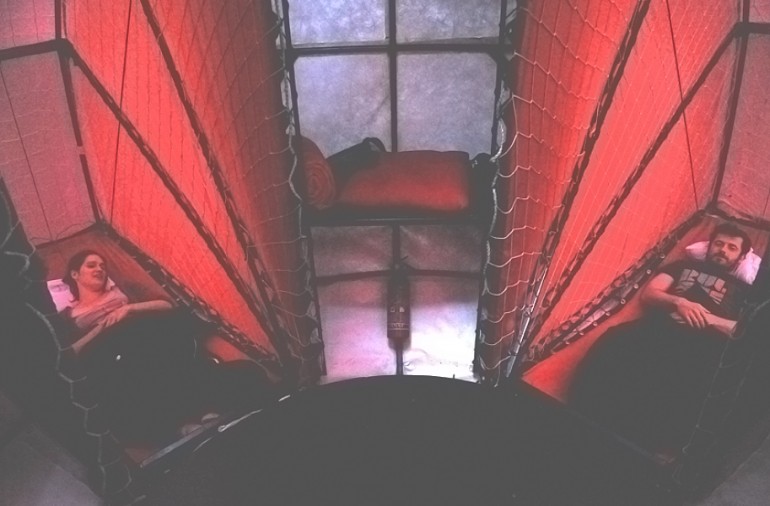
Looking for a place to stay that's sustainable, fun and suspended? The one-of-a-kind, mobile AirHotel, designed by a group of Belgian artists, may be just the ticket. Made from recycled materials, the quirky hotel's six elevated or hanging rooms are each unique in their own way and all come with an unusual form of room service that ranges from a love song to a disco party.
The solar-powered "Wellness Machine" is the nerve center for the unusual traveling complex (actually more motel than hotel) and houses reception, a bar and lounge, a sauna and the breakfast service. Guests stop there first before being whisked off for a tour of the entire facility.
The largest accommodation is the canvas-covered "Schulp" or "Little Cottage". With room for six guests in three distinct rooms, it floats 6.5 feet (2.5m) above the ground. Although it looks more like a screened in hanging porch than a place to stay, it's probably the least unusual looking of all the various rooms or pods.
Perched 13 feet (4m) up, the "Love Nest" does indeed resemble a bird's nest. It's basically a metal frame covered with wood and branches and doubtless gives guests a taste of the bird's life. Fake leather adorns the interior and a large portal window allows natural light to enter.
The "Sterreschijter", likely a challenge for those with a fear of heights, is firmly mounted 19.7 feet (6m) up and resembles an oversized baby carriage. The room's name, best left untranslated in the original Dutch, hints at the great views it affords of the starry night skies. It sleeps two.
For VIPs, there's "El Ambassador" - a deluxe cocoon-like pod made of wood with views provided through glass skylights that's accessed by a collapsible/retractable ladder. Securely anchored by four cables, its two guests sleep almost 7 feet (2.5m) up.
The "Lotus" is probably the most unusual of all the sleep chambers. When closed, it resembles a giant Japanese lantern but, like its namesake flower, opens into a giant four-petaled flower to accommodate four guests. Also suspended securely from four cables, it floats 13 feet (4m) above the ground.
For those not comfortable with being disconnected from the Earth, the "Night Box" is probably the way to go. The cube-shaped room sleeps two and sits atop a beefy steel frame that hoists it several feet off the ground. Its walls, fashioned from a hodge podge of random recycled materials, hinge down to allow access to the bed inside and the roof opens to bring fresh air and light to the occupants.
Reservations are now being taken for the period from May 11-26 when the AirHotel will be located at the Norfolk & Norwich Festival in the UK. Those lucky enough to book a night can expect to pay about US$57 each for a stay that likely won't soon be forgotten.
Sunday, May 6, 2012
Audi unveils first luxury-class e-tron concept car in Beijing
Audi has added to its e-tron series of electric and hybrid concept cars with the unveiling of the A6 L e-tron concept at 2012 Beijing Motor Show. Joining the Frankfurt, Detroit, A1, Spyder and A3 e-tron models, the A6 L e-tron concept is the company’s first luxury-class e-tron concept vehicle. Based on the new A6 L, it is a plug-in hybrid that boasts an electric-only driving range of 80 km (49.71 miles).
Audi chose Beijing to unveil the A6 L e-tron concept as the A6 L, which is produced at its Changchun plant in a joint venture with Chinese automaker, First Automobile Works (FAW), is the company’s bestselling model in China.
The concept vehicle combines a 2.0 TFSI engine outputting 155 kW (211 hp) and an electric motor generating a peak output of 70 kW (95 hp). It can be driven powered only by the internal combustion engine, only the electric drive, or in hybrid mode, with a hybrid control module choosing the best mode to maximize driving range.
An energy flow indicator on the instrument panel lets the driver know the current operating mode and which hybrid drive components are currently active. The display screen also shows the average fuel economy and amount of energy recovered over five-minute intervals.
Audi has also replaced the tachometer with a powerometer that indicates the total power of the drive system on a scale of zero to 100 percent. An auxiliary instrument displays the current charge state of the liquid-cooled lithium-ion battery that is located in a collision-protected space at the rear of the vehicle.
In electric mode, the vehicle boasts a range of 80 km (49.71 miles) at a constant speed of 60 km/h (37 mph). This is a big step up from the 3 km (1.86 mile) electric-only range offered by the electrified drive systems found in the company’s current Q5 Quattro, A6 and A8 hybrids.
The concept car has a body that is around 10 percent aluminum and is identical to that of the A6 L business sedan, with a 3.01 m (9.88 ft) wheelbase, 5.02 m (16.47 ft) length, 1.87 m (6.14 ft) width, and 1.46 m (4.79 ft) height. A single-frame grille with slender cross-bars and nearly-covered air intakes that are common to all e-tron models visually differentiate it from the production A6 L.
Audi says the use of aluminum results in a body that is around 15 percent lighter than comparable all-steel designs, and that all future Audi models will be lighter than their predecessors. This will be achieved through the use of combinations of lightweight materials, including carbon fiber-reinforced polymer (CFRP).
As the first luxury e-tron concept, the interior of the vehicle boasts all of the A6 line’s luxury-class features, including seat ventilation and massage functions, Bose surround sound system, deluxe air conditioner with air ionizer, and MMI navigation plus navigation system with touchpad character input and the ability to recognize 29,000 Chinese characters.
Driver assistance and safety systems include active lane change assist, parking assist, night vision assistance that highlights detected pedestrians, and a pre sense system designed to reduce the severity of accidents.
Although Audi designed the A6 L e-tron concept specifically around Chinese requirements, there’s no word on whether the car will make the leap from concept to production vehicle there or in other markets. However, the company has revealed the e-tron Frankfurt – also known as the R8 e-tron - will get a short production run later this year, while the A3 e-tron will enter full production in 2014. Audi says these will be followed by other “New Energy Vehicles.”
KeepCup blends the best elements of disposable and reusable coffee cups
KeepCup, which claims to be “the world’s first barista standard reusable coffee cup,” has arrived on the shores of Italy, bringing to 32 the number of countries where the cup is now available. Developed in 2009 in response to the large global waste generated from disposable coffee cups, KeepCup attempts to blend the best elements of disposable and reusable cups.
The KeepCup is the brainchild of brother and sister, Jamie and Abigail Forsyth. Horrified at the amount of waste generated by disposable coffee cups through their own cafés in Melbourne, Australia, they commissioned industrial design firm, Cobalt Niche, to come up with a practical commuter cup that replicates the form and function of disposable cups, but with added benefits of re-usability, recyclability and the opportunity to create your own individual flair.
The result is the KeepCup, designed as a four-part product to enable easy recycling that comfortably fits under the heads of most espresso machines. Claiming thermal properties similar to the phase change materials concept, the KeepCup should maintain the coffee’s temperature for up to 30 minutes.
Manufactured from single component materials: polypropylene for the cup; low-density polyethylene for the lid; silicone for the thermal band; and thermoplastic polyurethane for the plug. These materials, with the exception of silicone, can be recycled in domestic recycling in many parts of the world at the end of the product’s life (estimated to be four years). As well as durability and weight, the materials were chosen for their low embodied energy in manufacture.
Now available in 32 countries, the Keepcup launched in Italy this month during the Milan Design Fair through la Rinascente department stores. The company estimates that KeepCup users have saved at least 800,000 trees from pulp mills, diverted 26,000 tonnes of disposable cup waste and 2 billion disposable cups from landfill since the cup's introduction.
KeepCup prices start from €9.25 (US$12.15).
999Bottle tracks your mitigated environmental impact one water bottle at a time
We all know that using a stainless steel or polycarbonate water bottle is much more eco than using (and tossing) a disposable water bottle. It's kind of the trendy thing right now. But do you really know just how much garbage and energy that you're saving the Earth from? With the 999Bottle, it's easy to find out.
A simple but practical idea, the 999Bottle is a 24-oz. ( .7 L) stainless steel water bottle with one unique feature: a built-in, rubberized turn-dial that lets you keep track of the number of water bottles you're saving from the landfill. Every time you fill the 999Bottle, you simply turn the dial to tick off one more bottle saved.
The concept might seem almost too simple to warrant an entire product. After all, if you were really interested, you could get the exact same benefit by tracking bottles in your head or on paper. But who actually does that? The 999Bottle provides an instant reminder every time you open the tap or spring, so you actually will keep track.
Another advantage of the 999Bottle is that it comes with an accompanying iPhone app that puts your numbers into context. From what we've seen, some of the facts are trivial and whimsical (your number of bottles interpreted into how far Knight Rider's K.I.T.T. can turbo-boost the Hoff) and some are more factual (the number of miles you could travel on the oil saved from bottles). Either way, you get a little context and positive reinforcement for using the same water bottle day in and day out. The app also lets you team up with friends to track your collective impact.
The 999Bottle system was conceived as a means of closing the gap between knowledge and action. Plenty of people know that disposable bottles (or disposable anything) are wasteful and environmentally harmful, but a lesser number actually make a concerted effort to cut their usage. By adopting the 999Bottle, people will have more concrete motivation for abandoning disposables.
Artefact, the Seattle-based industrial design firm that conceived the 999Bottle, is currently trying to drum up funding on Kickstarter. Because it's a design firm, Artefact doesn't have manufacturing capabilities and is trying to get the funding needed to turn the bottle from smart design to market product.
IKEA is moving into "hybrid furniture" with its new all-in-one UPPLEVA range. Integrating a home entertainment unit with AV equipment from Chinese manufacturer TCL, the UPPLEVA comes with a full-HD, smart LED TV, a combined Blu-ray, DVD, and CD player, and a 2.1 sound system featuring a wireless subwoofer - all operated by a single remote control.
The idea behind the UPPLEVA (the Swedish word for experience) is to rid a home of all the wires that are an inevitable part of owning multiple devices. How much of a problem you view this as will likely determine your level of interest - as will the price of 6,500 Swedish kronor (around US$955).
As the video below shows, the customer chooses the size of TV that's right for them (between 24- and 46-inches) and the frame that suits their style. They then choose the piece of furniture that they want to have in their house, subject to self-assembly, naturally. The customization options available (as seen from 1:50 onwards) are impressive, with sizes, units, and colors to suit the majority of mainstream tastes.
While it's a fairly elegant solution, there is a glaring issue with an all-in-one system such as this: what happens when the technology moves on to something new? The television included at launch isn't 3D-capable, for instance, despite the fact 3D is rapidly becoming a standard feature in all new TV sets (regardless of the level of interest the average consumer has in the feature). IKEA may well offer a solution to this in the future, whereby you can replace individual components ... although this would seem to defeat the purpose of offering such an all-in-one system.
The UPPLEVA range will first be available in IKEA's home country of Sweden, as well as France, Germany, Italy, and Poland, in June 2012. The rest of the world will follow by the middle of 2013.
Kahuna Creations' Bombora is designed for street surfing
Several years ago, Utah-based Kahuna Creations innovated a sport it calls "land paddling." With the simple addition of a balled paddle, longboard skaters have been able to paddle their way around asphalt and concrete, bringing the burgeoning sport of stand-up paddleboarding onto dry land. Kahuna is now updating its land paddling line with a purpose-built longboard modeled after one of its surfboards. The new Bombora Longboard uses a big, surf-style design to make for what is reportedly a smooth, intuitive ride.
If you look at the board, you'll immediately notice it has a shape distinct from the typical longboard. The board is shaped after Kahuna's Black Coral Classic Surfboard, and unlike other longboards, it's purpose-built for land paddling.
Not only does the board use a more surf-styled shape, but it's practically as long as a surfboard. At just under 5 feet long (1.5 m) and 14 inches (35.6 cm) wide, the Bombora gives you a big, stable platform for making swooping, stick-assisted carves. Kahuna marketing manager Cory McBride told us that it's wide enough to stand on with both feet pointing forward, the same stance you'd use on a water-based paddleboard. It's also long enough to walk back and forth on.
The Bombora has 70-mm wheels, 10-inch trucks and carved out wheel wells to eliminate wheel bite. It's crafted from Baltic birch and weighs 17 lbs (7.7 kg). Dedicated land paddlers can get their Bombora boards now for US$250.
Friday, May 4, 2012
Peugeot unveils compact Urban Crossover Concept in Beijing
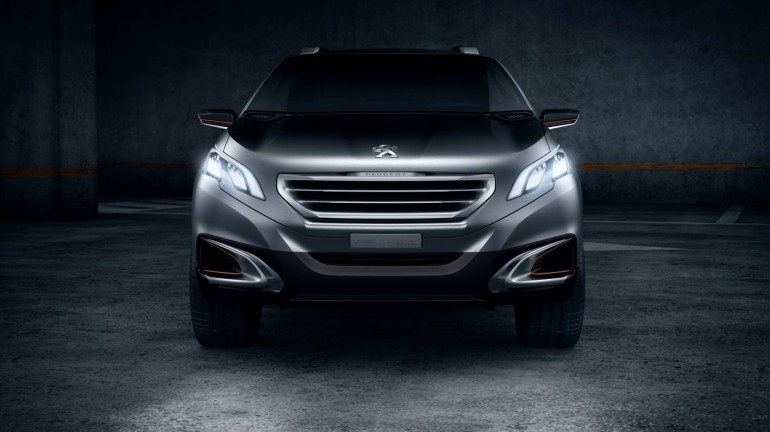
In the wake of the Bentley EXP 9 and Lamborghini Urus showings, yet another SUV has been unveiled at the 2012 Beijing Motor Show in the form of Peugeot’s Urban Crossover Concept. Essentially a refinement of the SXC Crossover Concept that appeared at the 2011 Shanghai Motor Show, the new concept vehicle is a compact SUV designed primarily for urban driving.
Leveraging its expertise in the compact car segment, Peugeot’s Urban Crossover Concept measures just 4.14 m (13.58 ft) long and 1.74 m (5.71 ft) wide. There are no details as to what lays under the hood, but the front end features the company’s new floating “smiling grille,” while the roofline was inspired by the RCZ coupé. The RCZ was also the inspiration for the double-bubble roofline and the aluminum spoiler mounted on the lip of the rear hatch.
The vehicle’s headlamps, coupled with the grille, are designed to give the car a “feline” look, which extends to the rear LED’s that light up in three lines to represent three floating claws of the company’s signature lion.
For those looking to escape the city, where the vehicle would most likely spend most of its time were it to enter production, the Urban Crossover features a raised body and large wheels.
Peugeot hasn’t revealed any plans to take the Urban Crossover Concept into production, but given the market popularity of the compact SUV segment and the fact that this latest concept features many of the same style cues seen on the SXC concept, signs are good that something similar will hit the market in the future.
Tuesday, May 1, 2012
Mercedes-Benz Sprinter Van outfitted like a private jet for New York Auto Show
Mercedes-Benz cars are pretty plush, luxurious vehicles, although even the most optioned-out S Class really can't compete with the pure comfort and style of a private jet ... but this Mercedes van can. The JetVan Sprinter was specially outfitted by Ventura, California-based Becker Automotive Design for display at the New York Auto Show. It brings a level of luxury that not even the average limousine can offer.
The spacious interior, which was purpose-built to emulate the interior of a private aircraft, is appointed in Townsend leather with Golden Birdseye Maple trim. There are four reclining, first-class-style leather seats with all kinds of legroom. Those seats are outfitted with adjustable leg supports, lumbar supports, massage systems and heating.
The electronics package puts most home entertainment systems to shame. A center-mounted, 40-inch high-definition Runco LCD TV is assisted by a 1,300-watt 7.1 channel speaker system drawing its sound waves from multi-channel McIntosh amplifiers. If work is more your thing, the Becker Sprinter has a 500-GB on-board computer with wireless 4G connectivity. A set of fold-out writing tables allow you to use a notebook computer or actual notebook. All functions – seats, entertainment, computers, lighting, blinds etc. – are controlled by six-inch Creston touchscreens located on either side.
In terms of the van itself, the Sprinter is powered by a 3.0-liter BlueTEC diesel engine. The engine is made cleaner by way of a Diesel Exhaust Fluid Injection (DEF) system that cuts down nitrogen emissions.
"Many of our clients view the Sprinter as making an environmental statement," said CEO Howard Becker. "They understand the significance and the fuel efficiency of a clean diesel engine, and their drivers appreciate being able to idle for an extended time while they wait outside a studio."
We're not too convinced that a huge van loaded with heavy equipment, all kinds of power-sucking electronics and only four passengers is a real environmental statement, but who wouldn't want to take a road trip in the back of this thing.
Becker works closely with its clients to design vans with just the right layout, materials and equipment. Its client list includes notables like Jerry Seinfeld, Will Smith and Bruce Springsteen. The company often works to duplicate clients' actual private aircraft features. It offers several different floor plans, and options include a couch, refrigerator and hidden toilet.
Becker lists pricing for its JetVans between US$200,000 and $450,000, but it doesn't specify whether that includes the cost of the base vehicle or just the upgrades.
Subscribe to:
Posts (Atom)