Thursday, April 5, 2012
Google X labs confirms augmented reality glasses project, releases video demo
Google X (Google's futuristic technology development lab) has pulled back the curtain on Project Glass, its program to develop truly useful augmented reality "Google glasses." Project Glass aims to design and refine augmented reality technology to help a user explore and share their world armed with a wealth of relevant information - not at their fingertips, but rather at the end of their nose.
Augmented reality describes a view of the real world that includes superimposed graphics. Instead of interrupting your activities to use a smartphone to search for information - get directions, remain in touch, find out if an item is on sale, translate a tourist's note evaluating a restaurant, and the like - Google's Project Glass intends to provide glasses with real-time heads-up displays and intelligent personal assistant software to enable a seamless user experience.
"We think technology should work for you - to be there when you need it and get out of your way when you don't. A group of us from Google[x] started Project Glass to build this kind of technology, one that helps you explore and share your world, putting you back in the moment," says a post signed by the three Google X team leaders, Babak Parviz, Steve Lee, and Sebastian Thrun. Parviz has experience working on contact lenses embedded with electronics, including one designed to monitor blood sugar levels - although AR contact lenses are probably still a little ways off yet.
In February 2012, the New York Times reported "the glasses [could] go on sale to the public by the end of the year." This seems a little ambitious, with the team needing to overcome a number of technical problems, from cost and adequate battery life to speed, network, software, and graphics performance. However, the video below gives an idea of the direction Google hopes to take the technology in.
Battery-powered plasma flashlight makes short work of bacteria
An international team of scientists has created a handheld, battery powered device that has been shown to effectively rid skin of bacteria in an instant by blasting it with plasma. The plasma flashlight, which shouldn’t be confused with a plasma torch that will damage much more than bacteria if used on the skin, could provide a convenient way for paramedics and military personnel to deal with harmful bacteria in the field.
The self-contained device is powered by a 12 V battery and doesn’t require any external gas feed or handling system. The plume of plasma it generates is between 20-23°C (68-73.4°F), so it won’t damage the skin. It is also fitted with resistors to stop it heating up and becoming too hot to touch. Its creators say it can also be easily manufactured at a cost of less than US$100 per unit.
In an experiment carried out by the scientists, the plasma flashlight effectively inactivated thick biofilms of Enterococcus faecalis, a bacterium that often infects the root canals in dental treatments and is highly antibiotic- and heat-resistant. Created by incubating the bacteria for seven days, the biofilms consisted of 17 different layers of bacteria. After treating each biofilm with the plasma flashlight for five minutes, the plasma was found to penetrate deep into the very bottom layer and inactivate the bacteria.
“In this study we chose an extreme example to demonstrate that the plasma flashlight can be very effective even at room temperature,” said co-author of the study, Professor Kostya (Ken) Ostrikov, from the Plasma Nanoscience Centre Australia, CSIRO Materials Science and Engineering. “For individual bacteria, the inactivation time could be just tens of seconds.”
While plasma has previously been shown to effectively kill bacteria and viruses on the surface of the skin and water, the exact mechanism behind this is still not understood. Ultraviolet radiation has been theorized as a reason, but the jet created by the plasma flashlight is low in UV radiation, which adds to the safety of using the device on a person’s skin. The reactions between the plasma and the surrounding air has also been suggested as another possibility.
The international team behind the plasma flashlight consists of scientists from Huazhong University of Science and Technology, CSIRO Materials Science and Engineering, The University of Sydney and the City University of Hong Kong. Their work is detailed in the Journal of Physics D: Applied Physics.
Cessna's Corvalis TTX, the world's fastest fixed-gear aircraft, enters production
Cessna seized upon the frankly unmissable opportunity to make a major announcement at this year's Sun 'n Fun International Fly-In at Lakeland, Florida. There it announced that its luxury single-pilot aircraft, the Cessna Corvalis TTX, has entered production. The new aircraft, proclaimed by Cessna to be the "world's fastest fixed-gear aircraft," will replace the old Corvalis TT.
The four-seater aircraft is powered by a turbocharged, fuel-injected, six-cylinder Continental Motor TCM TSIO-550-C engine which maxes out at 310 hp, granting a maximum speed of 235 knots (435 km/h). The aircraft has a usable fuel capacity of 102 US gallons (386 liters) allowing a range of 1,250 nautical miles (2,315 km) at economy-cruise speeds. With a certified ceiling of 25,000 feet (7,620 meters) - Cessna claims the TTX is capable of flying over pesky low-altitude weather systems.
We gather the most notable feature of the TTX is an optional de-icing system known as FIKI - Flight Into Known Icing, which provides a claimed 150 minutes of icing protection with minimal effect upon the TTX's performance. Cessna positions the feature as a potential money-saver, preventing the need to reschedule plans in the event of... known icing, presumably.
Perhaps more fundamental is the upgrade from the TT's avionics suite. The TTX includes the Cessna Intrinzic avionics suite, powered by the Garmin G2000 system and incorporating Garmin's GTC touch controls via a 14.1-inch high-def display. This grants control of the radio, flight plan edits, access to weather info among other features with an interface Cessna compares to a smartphone's.
"The TTX program has been moving steadily along through various certifications and testing phases," said Cessna's TTX business leader, Terry Shriner. "The production lines have begun the bonding processes on the all-composite TTX fuselage, as well as commencing work on the wing skins and internal components."
Varying paint designs and cabin interiors will be among the options. Deliveries are expected to commence by the end of the year. Pricing is not yet clear, though for reference the TT (sales of which have stalled of late) could be had for US$644,500 back in 2010.
New technologies detect seizures, and could possibly even eliminate them
Seizures can be very scary experiences for people who suffer from them, especially since they may sometimes result in the need for medical attention. Unfortunately, they often come on so fast that the people getting them aren’t able to get out a call for help beforehand – they simply have to ride out the seizure on their own, and hope for the best. Now, however, two new technologies may be able to help. One is a watch that alerts caregivers when it detects movements associated with seizures, while the other is a system that could stop seizures before they start, by sending electrical impulses to the brain.
A wearable alert device
The watch, known as the SmartWatch, is made by California-based tech company SmartMonitor. It can be worn 24 hours a day, and detects repetitive, excessive arm motions outside of the user’s regular movement spectrum, associated with grand mal seizures.
If they are able to, wearers can send out an alert to family members or other caregivers of their choice, simply by pressing a button on the watch. If not, within 15 to 30 seconds the watch will automatically send a Bluetooth signal to the user’s Android smartphone (which can’t be any farther than five feet away), which will in turn send that same alert to the same people. False alarms can be cancelled with the press of a button.
Afterwards, a secure record of the time, duration and geographical location of seizures can be accessed by the user, for possible onward use by health care professionals.
The SmartWatch is available in the U.S. as of today – the price has not yet been made public.
A system to stop seizures
At Baltimore’s Johns Hopkins University, meanwhile, assistant professor of biomedical engineering Sridevi V. Sarma is leading research into software that could more efficiently stop seizures before they happen.
Currently, when people are prone to seizures that don’t respond to drug treatment, they sometimes have electrodes surgically implanted in their brains. Algorithms running in an accompanying electronics package monitor the brain’s electrical activity, and cause the electrodes to administer a electrical pulse to the brain, when seizure-like activity is detected. While this setup is often effective at stopping the seizure from proceeding, it is also very prone to false alarms.
“They’re very good at detecting when a seizure is about to happen, but they also produce lots of false positives, sometimes hundreds in one day,” Sarma said of these systems. “If you introduce electric current to the brain too often, we don’t know what the health impacts might be. Also, too many false alarms can shorten the life of the battery that powers the device, which must be replaced surgically.”
Sarma and her team addressed this problem by analyzing the brain electrical activity of epilepsy patients, recorded before, during and after seizures. Specifically, they wanted to get a better idea of what sort of activity immediately preceded seizures. Once that activity was identified, they then trained their software to act only on it, while ignoring other types of activity that can confuse traditional systems.
When tested on recordings of the brain activity of four epilepsy patients, the system easily detected all of the actual seizures, but produced up to 80 percent less false alarms than conventional technology.
Sarma now plans on fine-tuning her software, using brain recordings from a further 100 patients. She hopes that within two to four years, it could be integrated into brain implants that could be used in clinical trials.
More information on both the SmartWatch and the Johns Hopkins software is available in the videos below.
LED learning sleeves for the guitar
Guitar tablature is a powerful form of musical notation, where learners are shown where to place a finger on the neck of an instrument, and in what order. Such things as timing, note duration and playing force are not given, so unless a student knows or has access to a recorded version of the song being learned, the result may be somewhat different from what the composer intended. Usefully, such missing elements can be included in software like Guitar Pro to show users exactly how a song should be played. Two projects have now appeared on crowd-funding portal Kickstarter that take this idea and put it directly onto the guitar, so that learners won't need to keep switching views from screen to instrument. Tabber and the LED Sleeve guide players to the correct finger positions via LED lights on the neck.
Along similar lines to Piano Maestro, both of the projects looking for funding on Kickstarter make use of LED lights to show students of the guitar where and when to place fingers while learning a song. While they might appear similar in concept, the design approaches and implementations differ quite a bit.
The Tabber system
Music Everywhere's Rob Sanchez, Ryan Rogowski and Kipp Bradford have developed a working prototype of a visual guidance system for the guitar, called Tabber. At the moment, version 0.9 has had sections of the neck removed at the first 12 frets and LED light modules inserted, but the production version currently being developed is to be a flexible sleeve that slides on top of the neck, under the strings.
"The sleeve construction that we are prototyping is extremely thin pieces of flex PCB with RGB lights on top, allowing users to control the color for things like different colored strings and eventually finger placement," Sanchez told Gizmag. "The goal is to create a standardized enough size so that it can be taken on or off any guitar. We may need a couple different versions for less common neck scale lengths in the future."
Designed for beginner to intermediate players, the system indicates finger positioning on the neck by lighting up an LED at the appropriate fret, with an open string getting its own strip of lights at the nut. Like tab notation, Tabber won't tell you what finger needs to be placed on the string but it will be able to say when to do so. There's no indication on how, or even if, the system will be able to instruct on techniques like hammer-ons, vibrato or bending, but maybe such things are not what Tabber is about.
"The point of Tabber is to get the basics of guitar presented in a way that people feel confident about," Sanchez explained. "There are a fair amount of people who just want to pick up the guitar and play along to their favorite songs and not sound horrible. Tabber gives people the confidence to become a full-time musician, or someone who just wants to play for fun."
The Tabber team has created a teaching app for smartphones that will connect to the sleeve via Bluetooth. The free-to-download iOS/Android app can also be used to activate the lights to, say, spell out the name of the band along the neck or perhaps treat the audience to a custom light show. In addition to LED-guided lessons, the app will also include video tutorials to help explain or improve technique.
"We are working on integrations with Spotify and Echo Nest to stream the audio of the track you are playing as well as recognizing the key that the song is in so we can help you jam along," said Sanchez. "You'll also be able to share what you are playing with your friends who can then play along to the same song. I'm very interested in a Turntable.fm-like functionality where you can practice with other people and all enjoy being able to play music."
"We have built a system where we can process any song tab available on the internet, so the technical abilities of our library are basically as extensive as it gets. Lining up the rights to the songs is the only thing that will keep us from being able to play any song on Tabber."
As a special incentive for top tier backers, the Tabber team - who run a community workshop called The Garage in Providence, Rhode Island - has enlisted the services of Nick Holcomb to build ten special Tabber guitars based on the version 1 prototype.
Unfortunately, indepth technical detail is currently being held back for a future feature in MAKE Magazine, for which Bradford is the Technical Editor.
The LED Sleeve
The appropriately-named LED Sleeve concept appeared on Kickstarter at around the same time as Tabber but the projects, while similar, are not linked. The working prototype from Matt Smith, Jason Newman and Clint Berry of musicalight runs for six frets only, looks to impact on the host guitar an awful lot less than Tabber, and also deals with open string indication a little differently. When an open string needs picking, all of the LED lights along the appropriate string are dimly lit.
Like Tabber though, the production version will use a flexible circuit board wrapped around the host instrument's neck. This will be connected to a clip-on controller attached to the guitar's head, from which cables can be run to a laptop or computer running proprietary software. The team has developed a guitar tab parser that converts standard tab in text documents into the system's custom format. Users will be able to control song tempo, perhaps starting off slow and gently increasing to correct song speed.
Players who are also coding addicts will benefit from the system's open API, which will allow such users full control of the sleeve - so once you've got your song down, you are free to show off by spelling out the name of your band in LED lights or just provide the audience with a custom light show.
Future plans include an integrated microphone for real-time feedback from a software tutor or to act as a built-in tuner, a web application for interacting with video lessons or connecting with friends on social network feeds, and the product's website will feature a user community for learners to share tips and tricks, or more experienced system users to share hacks.
In the following video, the project's Clint Berry gives a first look at the kind of thing we might expect to see when the project gets funded:
The Carapace – first building design by famous Italian artist Arnaldo Pomodoro
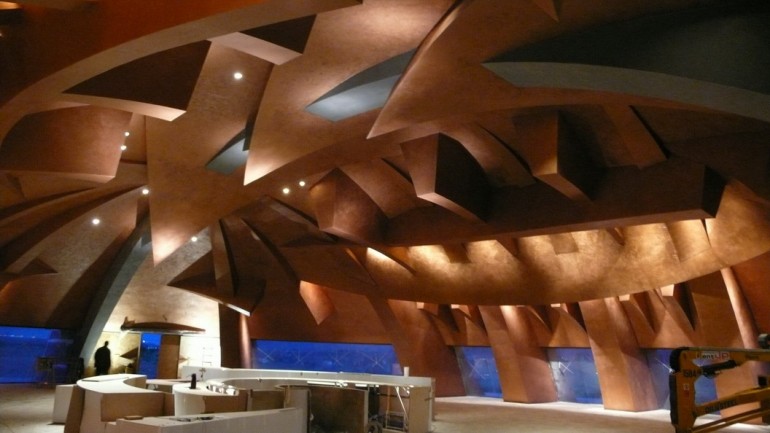
Italian sculptor Arnaldo Pomodoro, who created the famous "Sphere Within Sphere" located at the Vatican, has constructed his first-ever architectural sculpture. Titled “The Carapace,” the structure reflects its name by taking on the shape of a tortoise shell. The building, which will be inaugurated this June, is located on the Castelbuono Estate in Umbria, Italy. It marks the first time that the Italian master has created a work on such a grand scale.
The dome-like building is actually a giant copper sculpture, furrowed with "organic" shaped cracks that filter through natural daylight and ventilation. The large open interior is designed as a social space for visitors to walk through and taste the local wines, while enjoying 360 degree views of the surrounding 30 hectares (74 acres) of vines. The external facade of the dome has been designed to resemble the earth’s surface and has been decorated with copper plates, placed above several layers of roof ventilation.
The oval shape of the dome measures 35 x 28 meters (115 x 92 feet) and features 12 arch supports that rise up from the ground. To ensure that the building is flexible enough to meet seismic standards, the architects used a structural system of wooden arches that enables the structure to withstand the differential expansions related to the size of such a work.
The building also features a wine cellar that reaches 10 meters (33 feet) underground. The cellar is accessible by a dramatic central stairwell that is made from reinforced concrete, and resembles a giant cork screw.
Pomodoro’s overall intention for the landmark was to create a structure that sat in harmony with its surrounding landscape and symbolized a union between the earth and sky. Hence the idea of a turtle – a symbol of stability and the slow pace of country life.
CST-100 capsule landing system tested in 11,000 foot drop test
Boeing and Bigelow Aerospace conducted a series of tests in September 2011 that saw the Crew Space Transportation (CST)-100 mock capsule dropped from a specially designed horizontal rig to test the capsule’s airbags. These airbags are designed to cushion the capsule’s impact on landing and work in conjunction with three main parachutes that are deployed before the airbags are inflated. These parachutes were included in the latest test in which the capsule was dropped from an altitude of around 11,000 ft (3,353 m) to test these parachutes.
In the first drop test of the fully combined vehicle landing system the CST-100 test capsule was released from an Erickson Sky Crane helicopter in the skies above the Delmar Dry Lake Bed near Alamo, Nevada. The roughly 11,000 ft drop was a little short of the 12,000 ft (3,658 m) altitude that the three main parachutes are designed to be deployed at, but the parachutes successfully slowed the capsule’s descent before six air bags were inflated resulting in a smooth ground landing.
"This successful test is a tremendous milestone that brings Boeing one step closer to completing development of a system that will provide safe, reliable and affordable crewed access to space," said John Mulholland, vice president and program manager, Boeing Commercial Programs.
Following parachute inspection and re-packing, a second test drop planned for later this month to demonstrate the full parachute system performance will include a drogue parachute deployment sequence on top of the main parachute deployment. An additional series of landing air bag tests are scheduled for May, while an orbital maneuvering/attitude control engine hot fire test is slated for June.
Initial test flights of the CST-100, which is intended to transport crew to the International Space Station (ISS) and private space stations such as the proposed Bigelow Next-Generation Commercial Space Station, are scheduled for 2015-16 using the United Launch Alliance’s Atlas V launch vehicle.
Wednesday, April 4, 2012
Flutter brings (limited) gesture control to iTunes and Spotify
While developers are plugging away on Windows applications for Microsoft’s Kinect thanks to the release of the official Kinect for Windows SDK, Mac users can also get into the gesture control game – albeit in a much, (much) more limited way. Not requiring any additional hardware because it works using a Mac's built-in webcam, Flutter registers hand gestures – well, a hand gesture – to control playback in iTunes and Spotify.
Currently in alpha and available as a free download, Flutter allows music and videos in iTunes and music in Spotify to be played and paused by flashing the webcam a “talk to the hand” gesture. The application runs in the menu bar and allows control of iTunes and Spotify even when they’re running in the background. This is probably the biggest plus of the app, at least until it gets some more functionality and compatibility with a wider range of applications – both of which are in the works.
However, without the benefit of a depth sensor like the Kinect, the range of gestures will likely be limited. Nevertheless, having downloaded the app and given it a quick trial it seems to work pretty well. With no calibration required, it registers my open palm in under a second, even in low light. If I was the type to listen to music while I worked, I could definitely see myself using it to save me a few mouse clicks.
Flutter is currently only available for Macs and can be downloaded here.
Here’s a video showing Flutter in action.
Indian student's stunning personal transportation concept
Very little is known about this "single person transport system" concept dreamed up by the enigmatically-named product design student Sanu K R from Ernakulam on India's west coast, but one thing is clear: it's a head-turner.
What's obvious is that the vehicle encases a lone passenger inside a transparent bubble, propelled by two wheels either side of the cockpit. The side-by-side arrangement of the wheels means the vehicle would need to be self-balancing, so perhaps its designer envisages fluid- and gyroscope-based sensors like those employed in Segways.
The vehicle seems to be controlled by a small joystick located on the right armrest (strongly reminiscent of electric wheelchair controls), while there appears to be a large, chrome brake lever to the left of the driver's seat. At least one side of the vehicle opens up for access.
We've reached out to Sanu K R to tell us more about the concept. At this point it's unclear to what extent this is a visual portfolio piece, or whether the designer has specific technologies in mind that could, theoretically at least, turn the SPTS (hey, why not?) into a reality.
NASA investigates sending CubeSats to Phobos and back
NASA's Innovative Advanced Concepts Program provides funding to study a small number of highly advanced spaceflight concepts, with the goal of understanding the technological possibilities which will guide the development of future space missions. Under this program, a JPL (Jet Propulsion Laboratory) researcher has proposed the use of a pair of CubeSats for an autonomous mission to retrieve samples from Phobos, Mars' larger moon.
In its simplest form, a CubeSat is a cubical picosatellite that usually has an edge of 10 cm, a volume of a liter, and a mass less than 1.33 kg (2.9 lb). Several CubeSats can be connected together when needed to form a larger vehicle. They are built to strict specifications, so that CubeSats can hitchhike to space together with larger payloads without interfering with the primary mission, which helps keep the typical cost of a CubeSat mission to around US$100K. While CubeSats are usually released in relatively low Earth orbit, this is not a fundamental limitation.
So how do CubeSats get to Phobos on a budget? The study mission is based on the use of two coupled CubeSats, one of which is specialized as the drive vehicle and the other as the sample collector. A European study of a small, solar-powered ion motor for small satellites such as CubeSats has recently appeared, that suggests its use for lunar missions. The JPL study, however, focuses on solar sails.
Once placed in Earth orbit, the drive vehicle deploys a solar sail, which produces a thrust that can be controlled in magnitude and direction by embedded nanoactuators. This thrust slowly increases the altitude of the coupled CubeSats and directs them toward a suitable Lagrange point - perhaps the Earth-Moon L1 point located between the Earth and the Moon.
The Lagrange points in the solar system are passageways into the gravitationally defined Interplanetary Transport Network. This network is a collection of very low-energy orbits which connect the Lagrange points of the solar system. When the CubeSats are inserted into such a transfer orbit, virtually no energy input is required to travel to a similar Lagrange point near Mars. The energy difference between the CubeSats in Earth orbit and the CubeSats in Mars orbit when transferred via the Transport Network is supplied by other planetary bodies through gravitational slingshot maneuvers, so requires no energy input. True, the transfer orbit will be lengthy and indirect, and typically requires far longer than would a traditional Hohmann transfer orbit. However, the Hohmann transfer orbit to Mars orbit would require a change in velocity of about 6 km/s (3.7 miles/s) - a very expensive requirement.
Once the coupled CubeSats are in the vicinity of Mars, how do they manage to collect a sample of Phobos' surface material? Landing on Phobos is not a difficult feat, as the escape velocity is just over 10 meters per second (22 mph). However, the solar sails do not provide the force required to lift the lander CubeSat from Phobos, so it will have to be pulled free by the momentum of the drive CubeSat.
In this scenario, the two CubeSats will skim the surface of Phobos from a hyperbolic orbit. As the lander CubeSat approaches the surface, its motion relative to the surface is stopped by the action of a preset spring which pushes apart the two CubeSats. It is on the surface with very little relative motion, so it has "landed." A robotic scoop might be used to collect a surface sample, but even a sticky surface could do so.
If the two CubeSats remain connected by a tether, when the tether pulls tight both CubeSats will pull free of Phobos' gravitation. The CubeSats then navigate back to the Interplanetary Transit Network, and enter an appropriate zero-energy trajectory to return to Earth. Presumably the CubeSats would eventually dock with the ISS for recovery and transport to the surface.
The mission outlined here is not necessarily the easiest nor the most effective way to sample Phobos using a pair of CubeSats. However, it does illustrate the possibility of such scenarios. The real payoff of the study is to demonstrate the enormous potential of non-brute force approaches to space exploration - there are other ways to travel to other planets than by launching a nuclear-powered spacecraft.
Subscribe to:
Posts (Atom)