


Thursday, October 4, 2012
Sameera's Blog: Smartphone shipments tipped to pass one billion in...
Sameera's Blog: Smartphone shipments tipped to pass one billion in...: The latest research from NPD DisplaySearch suggests that the smartphone is quickly heading for ...

Smartphone shipments tipped to pass one billion in 2016

No doubt boosted by today's iPhone 5 announcement, smartphone shipments will reach 567 million in 2012 according to forecasts from NPD DisplaySearch. That number is expected almost double by 2016, putting annual smartphone shipments well beyond the one billion mark.
“Apple’s iPhone 5 will be a key product for the smartphone market in the second half of 2012." says Hiroshi Hayase, Vice President, Small/Medium Displays for NPD DisplaySearch. "Apple shipped more than 140 million phones in 2010 and 2011, so we can expect smartphone shipments to continue flourishing as users upgrade to the new iPhone.”

Friday, June 29, 2012
Video road test: 2012 Ducati Diavel

We love oddities and mold-breakers here at Gizmag. And in the motorcycle world, we're so used to seeing evolution rather than revolution that we get really excited when a new machine comes along that thinks outside the square. That's why we've been hanging out to throw a leg over Ducati's Diavel - it's the company's first foray into the cruiser market in recent years, and it takes a distinctly Italian approach to the genre. A laid-back musclebike style and enormous back tire make it look like a boulevard cruiser, but when you twist the throttle and unleash 160-plus horsepower through the screaming 1198 superbike engine it houses, you realize this is one right out of the box. Loz Blain and Noel McKeegan get to grips with the Ducati Diavel in the latest of our HD motorcycle review videos.
So here's what we understand a cruiser to be: a big, heavy, comfortable machine, with a gigantic twin-cylinder engine, preferably 1600cc or larger. Raked out forks to deliver stability at the expense of quick turning. Classic shapes to evoke the bad-boy, post Vietnam, Harley-riding outlaw gangs of the 70s, and low-set forward footrests that drag on the ground in the corners. Chrome everywhere, massive open exhausts, and lazy-torquey engines that emphasise foot-pounds over horsepower. Seats that look like saddles, and tanks that look like teardrops. Ornamental front brakes and strong rear ones.
The cruiser market is massive and growing as baby boomers age and look towards iconic shapes and relaxed rides. Ducati clearly wanted in, as part of its efforts to diversify away from its sports-only image in recent years. And here's what it came up with: the Diavel.

The Diavel Carbon, our test bike, looks like no cruiser you've ever seen. Its design is muscular and front-heavy, futuristic and foreboding - a far cry from a classic shape. Carbon fibre drips off its tank, front fender and rear seat cover, giving way to brushed metal and black paint finishes throughout. In place of the classic analogue cruiser gauges there's a twin digital dash, half LCD and half TFT screen.
And the differences between the Diavel and the rest of the cruiser class only get wider from there. Lazy engine? I don't think so. It's the high-revving superbike engine from the 1198 sportsbike. In a class where 100 horsepower is an impressive figure, the Diavel makes more than 160. Old-school tech never had a chance on this bike - it sports every one of Ducati's electronic engine management goodies, from fly-by-wire, to traction control, switchable engine maps and a lovely digital menu of options.


Leap Motion sensor offers 3D gesture control at an affordable price

Leap is now taking pre-orders for its Leap Motion sensor, a USB accessory that enables full control of your PC or Mac using simple hand and finger gestures. The company claims that its product is the most accurate gesture sensor available, and it costs only US$70.
As you can see, the Leap sensor is quite small, making it portable enough to throw into a laptop bag when traveling. Despite its small size, Leap claims that its device is 200 times more accurate than competitors such as Kinect for Windows. This raises a few questions, as Leap has not specified what technology powers its sensor. However, the company has stated that its device uses tech unlike anything else available.
Leap believes its sensor has an infinite number of uses. For starters there's basic PC navigation, controlling an operating system with your hands and fingers, and never touching a mouse or keyboard. There's also the potential for Leap to make a splash with PC gaming – thanks to the Leap API, developers can integrate Leap Motion controls in their games as they build them.
Strengthening the appeal of the Leap Motion sensor is its price, at $70. Thanks to the low entry cost, Leap has the potential to catch fire if the actual product lives up to the hype that its demo video has created. Leap is currently recruiting thousands of developers to ensure that its sensor will have plenty of applications available on launch day – which is anticipated to be in December of 2012 or January of 2013.
New "ReRAM" memory chip outdoes flash memory in speed, density and energy efficiency

These days, Flash memory is almost the defacto standard for data storage in consumer devices, being found in everything from PCs and digital cameras, to smartphones and USB thumb drives. But a team of researchers at University College of London (UCL) has developed a new type of memory chip that is much faster than Flash memory, while also offering greater storage densities and requiring much less power. Could the days of Flash memory's dominance be numbered?
The new chip developed at UCL is the first purely silicon oxide-based type of memory chip known as Resistive RAM, (ReRAM). These are memory chips based on materials, most commonly oxides of metals, that can remember the change in electrical resistance when a voltage is applied. The chip is also a so-called “memristor," a kind of electronic holy grail that took decades to be prototyped, with HP researchers finally clearing that hurdle in 2008 with the development of the first practical memristor that was based on titanium dioxide.
Memristors work similarly to brain neurons, with a continuously variable resistance that can be changed according to the current that passes through them and the value remembered once the power is turned off. This property, along with the fact the UCL team's new chip is based on silicon oxide, opens up the possibility of numerous applications, including their potential incorporation into not only memory, but also computer processors.

Because it does not require a vacuum to work and can operate in ambient conditions, the team says its chip is potentially cheaper and more durable than other silicon oxide chips currently in development. The chip's design also opens up the possibility of transparent memory chips for use in touch screens and mobile devices, with the team already working on making a quartz device that could be used in such transparent electronics.
Several top semiconductor companies have already approached the UCL researchers, attracted by the chip’s game-changing potential. “Our ReRAM memory chips need just a thousandth of the energy and are around a hundred times faster than standard Flash memory chips,” said Dr Tony Kenyon from UCL's Electronic and Electrical Engineering department.
Like a lot of great scientific discoveries, ReRAM was discovered by accident. The researchers were handling silicon oxide material to produce silicon LEDs when they noticed the devices appeared unstable. PhD student Adnan Mehonic looked into it and had his own eureka moment when he discovered that in reality the material alternated between conducting and non-conducting states in a predictable pattern that revealed memristor potential.
The structure and performance of the silicon oxide structure (and its switch in resistance) was recently described in a paper published in the Journal of Applied Physics.

Japan broadcasts Super Hi-Vision signal over the air

Japan's national public broadcaster NHK has revealed that it successfully broadcast a compressed Super Hi-Vision (SHV) signal carrying video at a resolution of 7680 x 4320, 16 times the resolution of regular HD. This is the first time that SHV has been transmitted over the air.
On April 15, NHK successfully broadcast the video via two channels of ultra-high frequency radio from the roof of its Science and Technology Research Laboratories. It was decoded at a distance of 4.2 km (2.6 miles) without error.
Japan's AV Watch reports that, across the two channels used (UHF31 and UHF34), a data transmission bandwidth of 183.6 Mbps was achieved.
Super Hi-Vision is NHK's preferred name for ultra high definition television (UHDTV) at this definition, also known as 8K (or 8K4K). It was one of two UHDTV standards defined by the Society of Motion Picture & Television Engineers in 2007, the other being the lesser 4K (or 4K2K) standard with a resolution of 3840 x 2160, as seen in UHDTVs by Samsung and Toshiba, as well as JVC's 4K2K camera. (JVC's D-ILA projector also discussed at the time supports 8K.) A frame rate of 120 frames per second for both UHDTV standards was subsequently agreed.
Siemens tests "eHighway of the Future" vision with tram-like overhead cables

With most major auto manufacturers now actively developing electric vehicles, the drive towards a zero emission personal electric transportation future seems very much on the horizon. Road pollution doesn't just come from cars of course, freight vehicles are also major players in choking our highways and byways. Siemens is currently testing a possible solution in Germany that's based on proven railway and tram technology but has been adapted for trucks on roads. Heavy goods vehicles have been fitted with a newly-developed pantograph that can automatically raise to meet overhead cables and transfer electric power to hybrid diesel/electric power trains. Energy recovered from regenerative braking can also be fed back into the system for re-use by other vehicles.

The Siemens eHighway concept announced at the 26th Annual Electric Vehicle Symposium in Los Angeles recently is a two part system. The first involves the rollout of a two pole catenary system along one or more lanes on freight transport routes that caters for two-way electricity transmission and ensures a reliable power supply by feeding the overhead wire via container substations. The substations used in the current test project feature a medium-voltage DC switching system, a power transformer, a rectifier 12-diode array and a controlled inverter (for the feedback of the electric energy generated by regenerative braking).
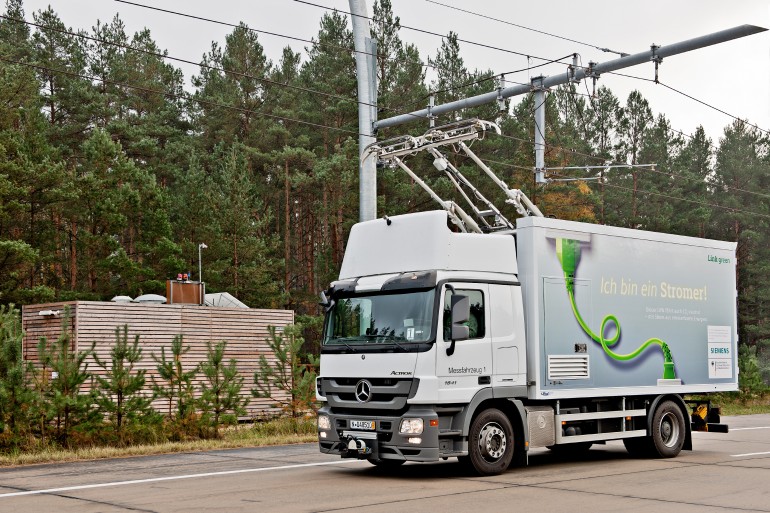
Heavy goods vehicles have been fitted with a brand new pantograph - the second part of the concept - with an intelligent control system that can either automatically connect to an overhead wire upon detection by a built-in scanner or be manually controlled by the driver. Installed above the driver's cabin, the system is said to be capable of detecting the relative position of the overhead contact wire to the pantograph and counterbalances any lateral movements of the truck via active horizontal adjustment.
The test vehicles have also been retro-fitted with diesel-electric power trains, where they are always powered by an efficient electric motor but when in diesel mode, the vehicle's engine powers a generator, which in turn drives a downstream motor and turns the cardan shaft. When traveling under eHighway electric power, the vehicle is driven by the electric motor only. Siemens says that the driver is not aware of the transitions between different drive modes.
The field trial in Germany is reported to have confirmed full performance potential, independent of weather, conditions and load. The concept proved to be at least as flexible as existing fuel-based road freight transport solutions thanks to the maneuverability of the mobile pantographs, with reduction in carbon dioxide, nitrogen oxide, soot and noise pollution and added fuel efficiency benefits. Keeping up with the flow of traffic doesn't appear to have been a problem either, with speeds of up to 90 km/h (55 mph) being reached without difficulty under direct transmission of electric power.
Moving beyond the proof of concept test phase, schemes for the electrification of ports and cargo centers are already being considered but the solution has great potential for expansion to inner city roads in much the same way as streetcars/trams, and of course onto major transport routes. Naturally, such an infrastructure could also readily support the electric power needs of pure battery electrics, vehicles with range extenders, or those fitted out for compressed natural gas.
Form follows function for Barcelona's Solar House 2.0

It's rare to see a building's form so adapted to maximizing renewable energy potential as is the case with the Endesa Pavilion, Solar House 2.0. Not content with a roof completely covered in photovoltaic panels, the designers at the Institute for Advanced Architecture of Catalonia (IAAC) led by Rodrigo Rubio have covered the building's south facade with protrusions supporting additional solar panels, which are angled optimally for harvesting energy from the sun.

In a neat twist the same protrusions act as solar barriers during summer when the sun tracks a higher course across the sky, but let sunlight directly in during winter. In this way solar heat gain is limited to the times of year when it's desirable. It's this interplay between maximizing PV gain, blocking solar penetration in summer but allowing it in winter that accounts for the south facade's diverse features: features which were generated by specialized software having been fed all of the geographic parameters.
Software was also intimately involved in the building's fabrication. A computer numerical control (CNC) wood router was used to fabricated pieces from the buildings CAD design data in a process similar to 3D printing, as seen in the WikiHouse we looked at recently.

The 154 sq m (1,658 sq ft) building was commissioned by energy company Endesa, and forms a public information center and "control center" for the Smart City Expo.
As for the productivity of the solar cells, we tracked down a clue on Endesa's website, which refers to "an average daily consumption of 20 kWh and an estimated output of 100 kWh." One interpretation for this is that on average the building generates 100 kWh of electricity but only uses 20 kWh, and consider that there is in the order of 150 sq m of photovoltaics on the roof alone, this doesn't seem beyond the realms of the possible.
The building itself is made almost entirely from wood, which the IAAC suggests is fitting for a building nicknamed Solar House 2.0. "We built a solar house with solar material," the IAAC writes on its blog. "Wood is a living material that grows in the sun. It is an inexhaustible material produced in culture. Is a soft, accessible, easy to work, adapt and join. It’s a warm material, which provides high thermal insulation."
The building stands at Barcelona's Moll de la Marina and will open to the public for Smart City Barcelona, taking place this coming November.


Microsoft launches So.cl social network

With decidedly little fanfare, Microsoft’s research-oriented FUSE Labs launched a new, student-oriented social network last weekend. While very much an experimental product at this point, So.cl (pronounced “social”) does highlight once more that the Redmond-based software giant is keen to keep its boffins thinking outside the box in order to find the next big thing, first.

So.cl has been put through a series of tests at the University of Washington, Syracuse University, and New York University since December 2011, and Microsoft has been very keen to manage expectations about the project. Rather than make any bold claims about So.cl being a white knight to usurp the reigning Facebook, the company seems instead to be headed in a different, altogether more academic direction, aiming to turn So.cl into a viable platform for younger people to share useful information quickly and easily. As a company blog post from December 2011 states:
“So.cl has been designed for students studying social media to extend their educational experience and rethink how they learn and communicate. They can build posts with many elements—photos, video, text, and more—and share them with colleagues. They also can find students with similar interests and build communities around specific educational goals. So.cl might even give students the ability to create their own social tool, customized for their own community.”

While the above features are interesting, they’re far from compelling and one could just as easily imagine another more established social network simply rolling such options into their existing platforms, thus nullifying So.cl’s merits. Once we also add the fact that fact that the service launched without any mobile support, it’s clear just how green this project actually is.
So, early days then and at this point it’s anyone’s guess as to whether So.cl will become Microsoft’s academic answer to Google+ or, rather, its Google Wave. You can decide for yourself, as So.cl is open to all comers and just needs a Facebook login or Windows Live account to get started.


Monday, June 25, 2012
gTar uses an iPhone to teach you the guitar

Learning to play any musical instrument can be a mammoth task, especially for those who aren't naturally gifted in that regard. The guitar is particularly difficult to learn to play, with a steep learning curve and some extraordinary finger dexterity required right from the start. Therefore, any tool designed to make the process less painful is welcomed with open arms by budding guitar gods. A company called Incident is hoping that will be the case for gTar, a new digital guitar that utilizes the power of the iPhone.

Incident, a company based in Santa Clara, California, has designed a new digital guitar it hopes will come to the aid of guitarists of all skill levels. The device looks like a cross between a real guitar and a Rock Band/Guitar Hero guitar; it's easy to spot it isn't "real" but it's more authentic than the videogame peripherals that appear to have peaked in popularity several years ago.
The gTar comprises a digital guitar with strings, frets and various other of the different components that make up the instrument. The big difference is the presence of an iPhone (4 or newer) running a specially-designed app.
Instead of pick-ups to amplify the sound of the string being strummed, the gTar has sensors along the neck that are able to detect, in real time, which note is being played. This information is then relayed to the iPhone docked in the body of the gTar, which produces the actual sound.

The app comes bundled with songs that the user can choose from to play along with. Despite the name, the gTar is not limited to guitar sounds, with the app making it entirely possible to play a grand piano by plucking the notes instead. Whatever the song and whatever the instrument, users have a choice of three levels of difficulty: Easy, Medium, and Hard.
Easy means just playing the open strings, and hitting the wrong string means no sound is produced. Medium adds fretwork to the mix, but there is still no danger of messing up thanks to the built-in SmartPlay feature. Hard means needing to play the correct notes; not doing so will result in every mistake being heard. This learning curve is the gTar's strength, as real guitars start and end on the Hard level of difficulty.
The gTar is initially being sold through a Kickstarter project. Incident asked for US$100,000 to fund the initial production run and has already raised more than that amount. Approximately $70,000 of the target was raised quickly by backers paying US$350 each to get their hands on the first 200 gTars produced. The company has stated the final retail price will be $449.
The device has also made an appearance at TechCrunch Disrupt 2012, where it was actually on show and demonstrated to work as advertised. This is an important step in the Kickstarter model, which requires a certain amount of trust to exist between the project creators and the project backers.

In the future, Incident plans on releasing an SDK (software development kit) that will allow third parties to create apps for the gTar. The possibilities are only limited by the breadth of developers' imaginations.
In conclusion, the gTar is a relatively expensive way to learn to play guitar. On top of the $350-and-up asking price for the gTar itself, you'll also need to own or buy an iPhone. However, this isn't just a learning tool. Even if and when you do reach Jimi Hendrix-like status, the gTar can still be used as a digital guitar to hone your skills on or to show off to friends. It also looks good.
There are other options to consider though, such as Rocksmith, a game/training tool available for PC, PS3, and Xbox 360. This lets you use a real electric guitar to play well-known songs with visual guidance. At least with Rocksmith you end up with a real guitar after the lessons have come to an end rather than a digital copy. There's also the iTar, which incorporates an iPad into a somewhat guitar-like body.
The video below shows the gTar in action along with some brief words from the founder and CEO of Incident.
Subscribe to:
Posts (Atom)